
|
You entered: outer Galaxy
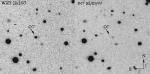 Historic Optical Flash Fades
22.04.1997
The largest telescopes in the world have scrambled to point toward this faint, fading object. Why? Because it may well be the first active optical counterpart ever found for a gamma-ray burst, and could hold the clue to the distance scale to this most enigmatic class of astronomical objects.
 An Immersive Visualization of the Galactic Center
22.01.2018
What if you could look out from the center of our Galaxy -- what might you see? Two scientifically-determined possibilities are shown in the featured video, an immersive 360-degree view which allows you to look around in every direction.
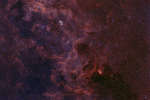 Cosmic Clouds in Cygnus
9.06.2022
These cosmic clouds of gas and dust drift through rich star fields along the plane of our Milky Way Galaxy toward the high flying constellation Cygnus. They're too faint to be seen with the unaided eye though, even on a clear, dark night.
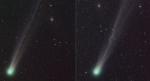 Comet C 2001 Q4 (NEAT)
23.04.2004
Inbound from the distant solar system, comet C/2001 Q4 will soon pass just inside planet Earth's orbit and should be one of two bright, naked-eye comets visible in southern skies in May. First...
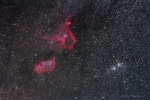 Heart and Soul and Double Cluster
24.09.2016
This rich starfield spans almost 10 degrees across the sky toward the northern constellations Cassiopeia and Perseus. On the left, heart-shaped cosmic cloud IC 1805 and IC 1848 are popularly known as the Heart and Soul nebulae.
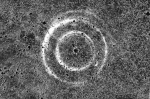 The Expanding Echoes of Supernova 1987A
24.02.2019
Can you find supernova 1987A? It isn't hard -- it occurred at the center of the expanding bullseye pattern. Although this stellar detonation was first seen in 1987, light from SN 1987A continued to bounce off clumps of interstellar dust and be reflected to us even many years later.
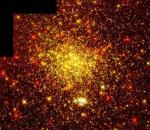 NGC1850: Star Cluster in the LMC
29.07.2000
NGC1850 is a large cluster of stars located a mere 166,000 light-years from Earth in our neighboring galaxy the Large Magellanic Cloud (LMC). The colors in this beautiful Hubble Space Telescope composite image of the cluster reveal different populations of stars.
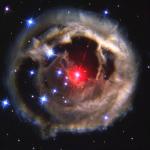 Light Echoes from V838 Mon
27.03.2003
Nominated for most mysterious star in the Milky Way, V838 Monocerotis briefly became one of the brightest stars in our galaxy. Its outburst discovered in January 2002, observations have indicated that V838 Mon somehow...
 APOD: 2024 January 29 Б The Pleiades: Seven Dusty Sisters
29.01.2024
The well-known Pleiades star cluster is slowly destroying part of a passing cloud of gas and dust. The Pleiades is the brightest open cluster of stars on Earth's sky and can be seen from almost any northerly location with the unaided eye.
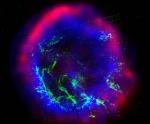 Supernova Remnant E0102 72 from Radio to X-Ray
14.04.2000
Not all stars form a big Q after they explode. The shape of supernova remnant E0102-72, however, is giving astronomers a clue about how tremendous explosions disperse elements and interact with surrounded gas. The above image is a composite of three different photographs in three different types of light.
|
January February March April May June July August September |
|||||||||||||||||||||||||||||||||||||||||||||||||