
|
You entered: NASA
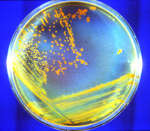 D. rad Bacteria: Candidate Astronauts
30.08.2009
These bacteria could survive on another planet. In an Earth lab, Deinococcus radiodurans (D. rad) survive extreme levels of radiation, extreme temperatures, dehydration, and exposure to genotoxic chemicals. Amazingly, they even have the ability to repair their own DNA, usually with 48 hours. Known as an extremophile, bacteria such as D.
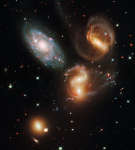 Stephan s Quintet
11.09.2009
The first identified compact galaxy group, Stephan's Quintet is featured in this stunning image from the newly upgraded Hubble Space Telescope. About 300 million light-years away, only four galaxies of the group are actually locked in a cosmic dance of repeated close encounters. The odd man out is easy to spot, though.
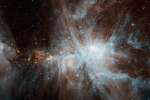 Spitzer s Orion
10.04.2010
Few cosmic vistas excite the imagination like the Orion Nebula, an immense stellar nursery some 1,500 light-years away. Spanning about 40 light-years across the region, this new infrared image from the Spitzer Space...
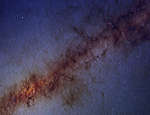 The Galactic Center in Infrared from 2MASS
30.05.2010
The center of our Galaxy is a busy place. In visible light, much of the Galactic Center is obscured by opaque dust. In infrared light, however, dust glows more and obscures less, allowing nearly one million stars to be recorded in the above image.
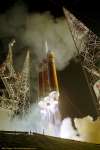 Launch of a Delta IV Heavy
14.12.2010
It is the tallest rocket in active use. The Delta IV Heavy is the largest of the Delta series, packing the punch of three rocket boosters instead of the usual one. The resulting rocket...
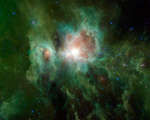 Infrared Orion from WISE
13.02.2013
The Great Nebula in Orion is a intriguing place. Visible to the unaided eye, it appears as a small fuzzy patch in the constellation of Orion. But this image, an illusory-color composite of four...
 Flying Over the Earth at Night
31.03.2013
Many wonders are visible when flying over the Earth at night. A compilation of such visual spectacles was captured recently from the International Space Station (ISS) and set to rousing music. Passing below are white clouds, orange city lights, lightning flashes in thunderstorms, and dark blue seas.
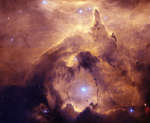 A Massive Star in NGC 6357
22.10.2013
For reasons unknown, NGC 6357 is forming some of the most massive stars ever discovered. One such massive star, near the center of NGC 6357, is framed above carving out its own interstellar castle with its energetic light from surrounding gas and dust.
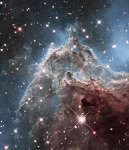 At the Edge of NGC 2174
3.04.2014
This fantastic skyscape lies near the edge of NGC 2174 a star forming region about 6,400 light-years away in the nebula-rich constellation of Orion. It follows mountainous clouds of gas and dust carved...
 The North and South Jupiter
14.09.2016
A wide, looping orbit brought Juno close to Jupiter on August 27. As the spacecraft swung around the giant planet's poles JunoCam acquired these premier direct polar views, a change from the usual nearly equatorial perspective of outbound spacecraft and the telescopes of planet Earth.
|
January February |
|||||||||||||||||||||||||||||||||||||||||||||||||