
|
You entered: outer Galaxy
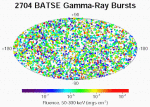 BATSE GRB Final Sky Map
28.06.2000
What causes the most powerful explosions in the universe? The BATSE modules that flew on the Compton Gamma Ray Observatory allowed more insight into enigmatic gamma-ray burst (GRB) explosions than ever before. From 1991-2000, BATSE detected 2704 GRBs, much more than ever previously recorded.
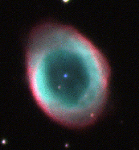 M57: The Ring Nebula
27.07.1995
A star with mass similar to that of our Sun will throw off its outer gasses after fusion has stopped in its core. Possibly the most visually spectacular of these planetary nebula is the pictured Ring Nebula. The appearance as a ring is really an illusion of projection - the nebula is actually a spherical shell.
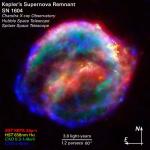 Kepler s SNR from Chandra, Hubble, Spitzer
8.10.2004
Light from the stellar explosion that created this energized cosmic cloud was first seen on planet Earth in October 1604, a mere four hundred years ago. The supernova produced a bright new star in early 17th century skies within the constellation Ophiucus.
 Dark Markings of the Sky
25.04.2009
Based on wide field photographs, American astronomer Edward Emerson Barnard cataloged the dark markings of the sky in the early 20th century. Barnard's markings are dark nebulae, interstellar clouds of obscuring gas and dust.
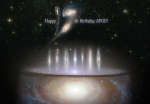 APOD Turns 17
16.06.2012
The first APOD appeared seventeen years ago today, on 1995 June 16. Although garnering only 14 page views on that day, we are proud to estimate that APOD has now served over one billion space-related images over the last 1.7 decades.
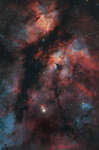 The Gamma Cygni Nebula
18.06.2022
Supergiant star Gamma Cygni is at the center of the Northern Cross. Near the plane of our Milky Way galaxy, that famous asterism flies high in northern summer night skies in the constellation Cygnus the Swan.
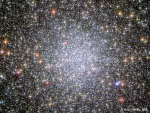 Globular Star Cluster 47 Tuc
19.05.2015
Globular star cluster 47 Tucanae is a jewel box of the southern sky. Also known as NGC 104, it roams the halo of our Milky Way Galaxy along with over 150 other globular star clusters.
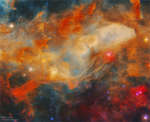 The Blue Horsehead Nebula in Infrared
23.04.2018
The Blue Horsehead Nebula looks quite different in infrared light. In visible light, the reflecting dust of the nebula appears blue and shaped like a horse's head. In infrared light, however, a complex labyrinth of filaments, caverns, and cocoons of glowing dust and gas emerges, making it hard to even identify the equine icon.
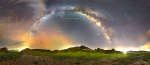 Perseids Around the Milky Way
17.08.2020
Why would meteor trails appear curved? The arcing effect arises only because the image artificially compresses (nearly) the whole sky into a rectangle. The meteors are from the Perseid Meteor Shower that peaked last week.
 Video: Powers of Ten
4.12.2022
How different does the universe look on very small scales? On very large scales? The most famous short science film of its generation gives breathtaking comparisons. That film, Powers of Ten, originally created in the 1960s, has been officially posted to YouTube and embedded here.
|
January February March April May June July August September |
|||||||||||||||||||||||||||||||||||||||||||||||||