
|
You entered: image
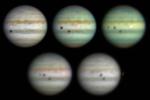 A Triple Eclipse on Jupiter
1.02.1998
Part of Jupiter is missing. Actually, three parts appear to be missing. In reality though, the three dark spots seen in the above photograph are only shadows. The unusual alignment of three of Jupiter's moons between the Jovian giant and the Sun was imaged last November 10th.
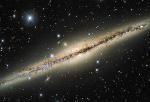 Interstellar Dust Bunnies of NGC 891
3.07.2002
What is going on in NGC 891? This galaxy appeared previously to be very similar to our own Milky Way Galaxy: a spiral galaxy seen nearly edge-on. However, recent high-resolution images of NGC 891's dust show unusual filamentary patterns extending well away from its Galactic disk.
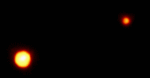 Pluto: The Frozen Planet
18.08.1995
The Hubble Space Telescope imaged Pluto and its moon Charon in 1994. Pluto is usually the most distant planet from the Sun but because of its elliptic orbit Pluto crossed inside of Neptune's orbit in 1979 and will cross back out again in 1999.
 Asteroid Annefrank
12.11.2002
NASA's interplanetary probe STARDUST, on its way to Comet Wild 2 in January 2004, passed asteroid 5535 Annefrank earlier this month. Annefrank, named for a holocaust victim who kept a famous diary, is a member of the main asteroid belt between Mars and Jupiter.
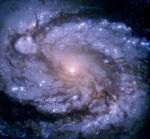 M100: A Grand Design
1.06.1997
Majestic on a truly cosmic scale, M100 is appropriately known as a Grand Design spiral galaxy. A large galaxy of over 100 billion or so stars with well defined spiral arms, it is similar to our own Milky Way.
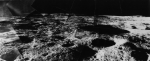 Surveyor Hops
4.12.1998
This panorama of the cratered lunar surface was constructed from images returned by the US Surveyor 6 lander. Surveyor 6 was not the first spacecraft to accomplish a soft landing on the Moon ... but it was the first to land and then lift off again!
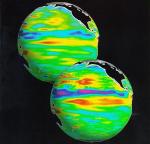 El Nino Water Rhythm
12.01.1998
This year's El Niño is the strongest ever recorded. The large amount of warm water in the Pacific Ocean near the equator is causing unusual weather all over planet Earth.
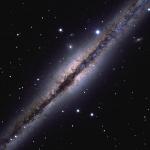 Interstellar Dust Bunnies of NGC 891
17.03.1998
What is going on in NGC 891? This galaxy appeared previously to be very similar to our own Milky Way Galaxy: a spiral galaxy seen nearly edge-on. However, recent high-resolution images of NGC 891's dust show unusual filamentary patterns extending well away from its Galactic disk.
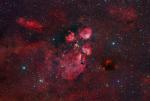 The Cats Paw Nebula
28.06.2006
Nebulae are perhaps as famous for being identified with familiar shapes as perhaps cats are for getting into trouble. Still, no known cat could have created the vast Cat's Paw Nebula visible in Scorpius.
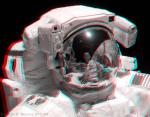 STS 115: Stereo Portrait
30.09.2006
On September 12, astronaut Heidemarie Stefanyshyn-Piper snapped photos of her colleague Joseph Tanner during the STS-115 mission. At the time, the spacesuited pair were working outside the shuttle orbiter Atlantis, some 300 kilometers above planet Earth.
|
January February March April May June July August September |
|||||||||||||||||||||||||||||||||||||||||||||||||