
|
You entered: star trail
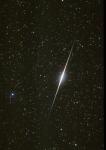 Iridium 52: Not A Meteor
22.10.1999
While hunting for meteors in the night sky above the White Mountains near Bishop, California, astrophotographer James Young instead captured this brilliant celestial apparition. Recorded near twilight on August 13, the bright streak is not the flash of a meteor trail but sunlight glinting from a satellite.
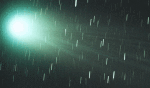 Comet Hyakutake's Closest Approach
24.03.1996
The above true color image of Comet Hyakutake was taken the night of March 21/22. Tonight, Comet Hyakutake will make its nearest approach to Earth, closing to a mere 10 million miles as it passes over the planet's Northern Hemisphere.
 Northern Lights from the Stratosphere
18.01.2024
Northern lights shine in this night skyview from planet Earth's stratosphere, captured on January 15. The single, 5 second exposure was made with a hand-held camera on board an aircraft above Winnipeg, Canada. During the exposure, terrestrial lights below leave colorful trails along the direction of motion of the speeding aircraft.
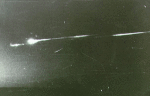 A Meteoric View of Apollo 13
9.07.1995
Meteors, also called shooting stars, normally begin as bits of dust from the tails of comets or even small pieces chipped off asteroids. Falling toward Earth, these particles enter the atmosphere at extremely high speeds. Friction with the air heats them up and makes them glow brightly.
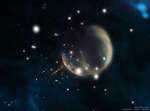 Supernova Cannon Expels Pulsar J0002
13.08.2019
What could shoot out a neutron star like a cannon ball? A supernova. About 10,000 years ago, the supernova that created the nebular remnant CTB 1 not only destroyed a massive star but blasted its newly formed neutron star core -- a pulsar -- out into the Milky Way Galaxy.
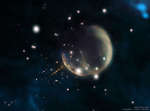 Supernova Cannon Expels Pulsar J0002
2.10.2022
What could shoot out a neutron star like a cannon ball? A supernova. About 10,000 years ago, the supernova that created the nebular remnant CTB 1 not only destroyed a massive star but blasted its newly formed neutron star core -- a pulsar -- out into the Milky Way Galaxy.
 Machholz Meets the Pleiades
11.01.2005
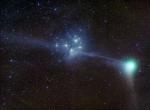
Sweeping northward in planet Earth's sky, comet Machholz extended its long ion tail with the Pleiades star cluster in the background on January 7th. This stunning view, recorded with a telephoto lens in skies over Oberjoch, Bavaria, Germany, emphasizes faint, complex tail structures and the scene's lovely blue and green colors.
 Asteroid 3753: Earth's Curious Companion
18.06.1997
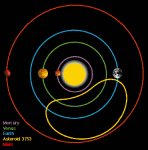
Earth is not alone. It orbits the Sun with a small companion: Asteroid 3753. First discovered in 1986 and designated 1986 OT, this five kilometer rock was recently found to orbit the Sun while executing a strange dance with the Earth. A portion of the asteroid's complex orbit is shown above.
 Lyrid Meteor and Milky Way
1.05.2009
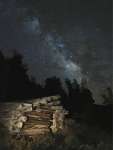
On April 22nd, the Lyrid Meteor Shower visited planet Earth's sky, an annual shower produced as the Earth plows through dust from the tail of comet Thatcher. Usually Lyrid meteor watchers see only a drizzle.
 Comet NEOWISE and Nebulae
20.07.2020
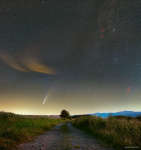
Would you brave wild animals to photograph this sky? One astrophotographer did -- and we all get to reap the rewards. First, thousands of stars were visible with many of the brightest impressively blue. Next, several red-glowing nebulae were discernible, including the California Nebula on the far right, and, above it, the Heart and Soul nebulae.
|
January February March April May June July August September October |
|||||||||||||||||||||||||||||||||||||||||||||||||