
|
You entered: phase
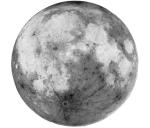 Full Moondark
28.07.2007
The brilliant full Moon might not look quite like this to skygazers next Monday, but the image is a mosaic of 18 digital frames recorded when the Moon was only about seven hours past its exact full phase or time of maximum illumination as viewed from Earth.
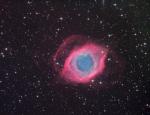 NGC 7293: The Helix Nebula
3.08.2007
A mere seven hundred light years from Earth, in the constellation Aquarius, a sun-like star is dying. Its last few thousand years have produced the Helix Nebula (NGC 7293), a well studied and nearby example of a Planetary Nebula, typical of this final phase of stellar evolution.
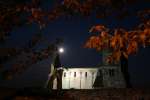 Equinox and Harvest Moon
24.09.2010
Did you enjoy the moonlight last night? The Full Moon closest to autumnal equinox and the beginning of Fall is traditionally known as the Harvest Moon, rising opposite the Sun and illuminating fields at harvest time after sunset. This year's northern hemisphere autumnal equinox occurred yesterday, September 23rd, at 03:09 Universal Time.
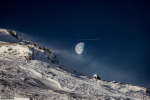 Gibbous Moon beyond Swedish Mountain
19.11.2018
This is a gibbous Moon. More Earthlings are familiar with a full moon, when the entire face of Luna is lit by the Sun, and a crescent moon, when only a sliver of the Moon's face is lit.
 NGC 1360: The Robin's Egg Nebula
5.08.2023
This pretty nebula lies some 1,500 light-years away, its shape and color in this telescopic view reminiscent of a robin's egg. The cosmic cloud spans about 3 light-years, nestled securely within the boundaries of the southern constellation Fornax. Recognized as a planetary nebula, egg-shaped NGC 1360 doesn't represent a beginning though.
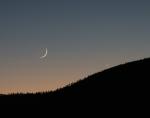 Venus and the 37 Hour Moon
25.12.2003
At Table Mountain Observatory, near Wrightwood California, USA on October 26, wild fires were approaching from the east. But looking toward the west just after sunset, astronomer James Young could still enjoy this comforting view of a young crescent Moon and brilliant Venus through the the fading twilight. Setting over the horizon of Mt.
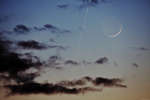 Jupiter and the Moons of Earth
27.04.2012
Planet Earth has many moons. Its largest artifical moon, the International Space Station, streaks through this lovely skyview with clouds in silhouette against the fading light of a sunset. Captured from Stuttgart, Germany last Sunday, the frame also includes Earth's largest natural satellite 1.5 days after its New Moon phase.
 APOD: 2024 December 23 Б Christmas Tree Aurora
23.12.2024
It was December and the sky lit up like a Christmas tree. Shimmering, the vivid green, blue, and purple auroral colors that formed the tree-like apparition were caused by high atmospheric oxygen and nitrogen reacting to a burst of incoming electrons.
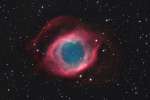 NGC 7293: The Helix Nebula
8.01.2011
A mere seven hundred light years from Earth, in the constellation Aquarius, a sun-like star is dying. Its last few thousand years have produced the Helix Nebula (NGC 7293), a well studied and nearby example of a Planetary Nebula, typical of this final phase of stellar evolution.
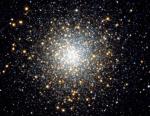 Hydrogen, Helium, and the Stars of M10
30.06.2001
Stars like the Sun use hydrogen for fuel, "burning" hydrogen into helium at their cores through nuclear fusion. But what happens when that hydrogen runs out? For a while, hydrogen burns in a shell surrounding the stellar core and the star expands to become a red giant.
|
January February March April May June July August |
||||||||||||||||||||||||||||||||||||||||||||||||||||||||