
|
You entered: molecular cloud
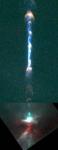 HH111's 12 Light-Year Star Jet
21.03.2000
The complex interactions of three stars in the Orion B molecular cloud complex have resulted in the ejection of particles along a 12 light-year long jet. One of the stars in the HH111 system has apparently also been ejected leaving two stars tightly bound in a binary orbit.
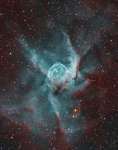 NGC 2359: Thor s Helmet
16.02.2019
NGC 2359 is a helmet-shaped cosmic cloud with wing-like appendages popularly called Thor's Helmet. Heroically sized even for a Norse god, Thor's Helmet is about 30 light-years across. In fact, the helmet...
 Massive Star Forming Region DR21 in Infrared
14.04.2004
Deep in the normally hidden recesses of giant molecular cloud DR21, a stellar nursery has been found creating some of the most massive stars yet recorded. The orbiting Spitzer Space Telescope's Infrared Array Camera opened the window into the cloud last year in mid- infrared light.
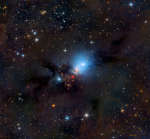 NGC 1333 Stardust
6.03.2014
NGC 1333 is seen in visible light as a reflection nebula, dominated by bluish hues characteristic of starlight reflected by dust. A mere 1,000 light-years distant toward the heroic constellation Perseus, it lies at the edge of a large, star-forming molecular cloud.
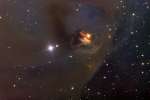 T Tauri and Hind s Variable Nebula
26.03.2011
The yellowish star near center in this remarkable telescopic skyview is T Tauri, prototype of the class of T Tauri variable stars. Nearby it is a dusty yellow cosmic cloud historically known as Hind's Variable Nebula (NGC 1555).
 Sharpless 115
14.06.2013
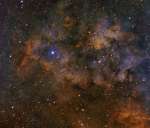
Sharpless 115 stands just north and west of Deneb, the alpha star of Cygnus the Swan in planet Earth's skies. Noted in the 1959 catalog by astronomer Stewart Sharpless (as Sh2-115) the faint...
 Herbig Haro 24
18.12.2015
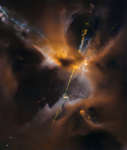
This might look like a double-bladed lightsaber, but these two cosmic jets actually beam outward from a newborn star in a galaxy near you. Constructed from Hubble Space Telescope image data, the stunning scene...
 The Antennae Galaxies in Collision
3.12.2020
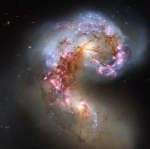
Sixty million light-years away toward the southerly constellation Corvus, these two large galaxies are colliding. The cosmic train wreck captured in stunning detail in this Hubble Space Telescope snapshot takes hundreds of millions of years to play out. Cataloged as NGC 4038 and NGC 4039, the galaxies' individual stars don't often collide though.
 Vista with NGC 2170
15.10.2010
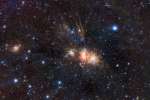
Drifting through the one-horned constellation Monoceros, these dusty streamers and new born stars are part of the active Monoceros R2 star-forming region, embedded in a giant molecular cloud. The cosmic scene was recorded by the VISTA survey telescope in near-infrared light.
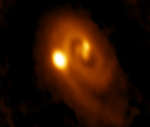 A Triple Star is Born
2.12.2016
A triple star system is forming, enshrouded within this dusty natal disk some 750 light-years away in the Perseus molecular cloud. Imaged at millimeter wavelengths by the Atacama Large Millimeter/submillimeter Array (ALMA) in Chile...
|
January February March April May |
|||||||||||||||||||||||||||||||||||||||||||||||||