
|
You entered: dust cloud
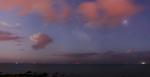 Constellations and Cloudy Skies
11.07.2007
Recorded earlier in July, the clouds of planet Earth reflect moonlight and a faint, reddish glow in this serene sea and skyscape. Beyond them lie the cosmic dust and star clouds of the Milky Way.
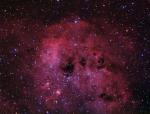 IC 410 and NGC 1893
15.08.2006
A faint, dusty rose of the northern sky, emission nebula IC 410 lies about 12,000 light-years away in the constellation Auriga. The cloud of glowing hydrogen gas is over 100 light-years across, sculpted by stellar winds and radiation from embedded open star cluster NGC 1893.
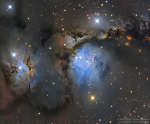 M78 and Orion Dust Reflections
24.01.2017
In the vast Orion Molecular Cloud complex, several bright blue nebulas are particularly apparent. Pictured here are two of the most prominent reflection nebulas - dust clouds lit by the reflecting light of bright embedded stars. The more famous nebula is M78, in the image center, cataloged over 200 years ago.
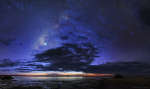 Night Hides the World
7.02.2014
Stars come out as evening twilight fades in this serene skyscape following the Persian proverb "Night hides the world, but reveals a universe." In the scene from last November, the Sun is setting over northern Kenya and the night will soon hide the shores of Lake Turkana, home to many Nile crocodiles.
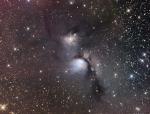 M78: Stardust and Starlight
4.11.2005
Interstellar dust clouds and bright nebulae abound in the fertile constellation of Orion. One of the brightest, M78, is just below center in this sharp widefield view, covering an area north of Orion's belt. At a distance of about 1,500 light-years, the bluish nebula itself is about 5 light-years across.
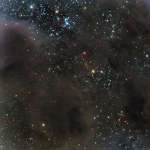 Chamaeleon II Dark Cloud
2.08.2019
A small constellation hiding near the south celestial pole, The Chamaeleon boasts no bright stars. Stars are forming within its constellation boundaries though, in a complex of dark, dusty molecular clouds. Some 500 light-years...
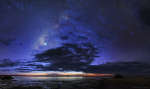 Night Hides the World
16.10.2015
Stars come out as evening twilight fades in this serene skyscape following the Persian proverb "Night hides the world, but reveals a universe." The scene finds the Sun setting over northern Kenya and the night will soon hide the shores of Lake Turkana, home to many Nile crocodiles.
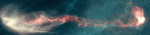 HH-47 Star Jet
12.10.1995
The star masked by a dust cloud at the left of the above photo is expelling an energetic beam of charged particles into interstellar space. This jet, moving from left to right, has burrowed through much interstellar material, and now expands out into the interstellar space.
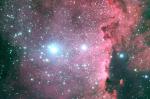 Hot Stars in the Southern Milky Way
7.05.1999
Hot blue stars, red glowing hydrogen gas, and dark, obscuring dust clouds are strewn through this dramatic region of the Milky Way in the southern constellation of Ara (the Altar). About 4,000 light-years from Earth, the stars at the left are young, massive, and energetic.
 Hot Stars in the Southern Milky Way
22.12.2001
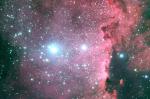
Hot blue stars, red glowing hydrogen gas, and dark, obscuring dust clouds are strewn through this dramatic region of the Milky Way in the southern constellation of Ara (the Altar). About 4,000 light-years from Earth, the stars at the left are young, massive, and energetic.
|
January February March April May June July August September |
|||||||||||||||||||||||||||||||||||||||||||||||||