
|
You entered: Earth's rotation
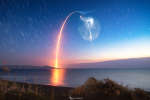 South Celestial Rocket Launch
28.02.2020
At sunset on December 6 a Rocket Lab Electron rocket was launched from a rotating planet. With multiple small satellites on board it departed on a mission to low Earth orbit dubbed Running Out of Fingers from Mahia Peninsula on New Zealand's north island.
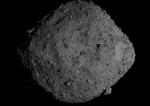 Descending Toward Asteroid Bennu
12.10.2020
What would it be like to land on an asteroid? Although no human has yet done it, NASA's robotic OSIRIS-REx spacecraft is scheduled to attempt to touch the surface of asteroid 101955 Bennu next week.
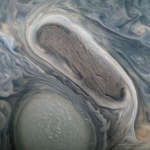 Giant Storms and High Clouds on Jupiter
29.12.2021
What and where are these large ovals? They are rotating storm clouds on Jupiter imaged last month by NASA's Juno spacecraft. In general, higher clouds are lighter in color, and the lightest clouds visible are the relatively small clouds that dot the lower oval.
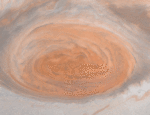 Galileo Zooms in on Jupiter's Red Spot
27.08.1996
What does the largest storm system ever recorded look like close-up? This storm system is Jupiter's Great Red Spot and it was captured recently in detail by the robot spacecraft Galileo now in orbit around Jupiter.
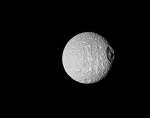 Mimas, Crater, and Mountain
11.01.2017
Mimas is an icy, crater-pocked moon of Saturn a mere 400 kilometers (250 miles) in diameter. Its largest crater Herschel is nearly 140 kilometers wide. About a third the diameter of Mimas itself, Herschel crater gives the small moon an ominous appearance, especially for scifi fans of the Death Star battlestation of Star Wars fame.
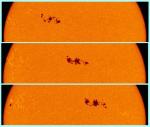 Sunspot Region 30
18.07.2002
The solar active region designated number 0030 is now appearing on the visible hemisphere of the closest star. Dwarfed by the Sun's disk, the group of sunspots which make up region 30 actually cover an enormous area -- nearly 10 times the size of Earth.
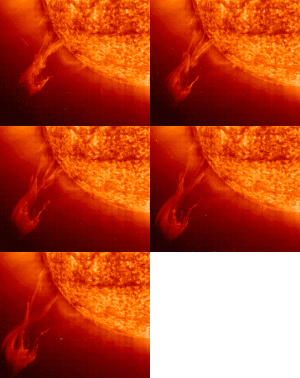 A Twisted Solar Eruptive Prominence
3.04.2000
A huge eruptive prominence is seen moving out from our Sun in this condensed half-hour time-lapse sequence. Ten Earths could easily fit in the "claw" of this seemingly solar monster. This large prominence, though, is significant not only for its size, but its shape.
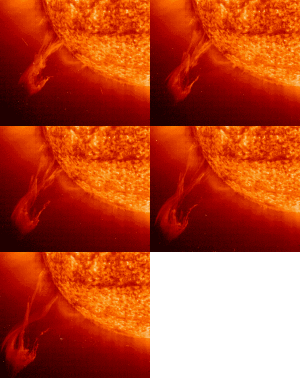 A Twisted Solar Eruptive Prominence
24.01.2015
Ten Earths could easily fit in the "claw" of this seemingly solar monster. The monster, actually a huge eruptive prominence, is seen moving out from our Sun in this condensed half-hour time-lapse sequence. This large prominence, though, is significant not only for its size, but its shape.
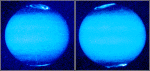 Jupiter's Auroras
18.10.1996
Auroras are especially large on Jupiter. In pictures released yesterday, the Hubble Space Telescope imaged these unusual light displays in more detail than ever before. Jupiter's auroras are linked to its volcanic moon Io.
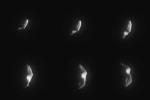 NEAR to Asteroid Eros
28.12.1998
On December 23, the NEAR spacecraft flew by asteroid 433 Eros. NEAR was originally scheduled to brake and orbit Eros, but an unexpected shutdown of its main engine caused this plan to be aborted. NEAR will now be reset and attempt to return to orbit Eros in early 2000.
|
January February March April May June July August September October |
|||||||||||||||||||||||||||||||||||||||||||||||||