
|
You entered: clouds
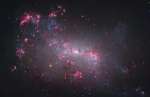 NGC 4449: Close up of a Small Galaxy
24.02.2011
Grand spiral galaxies often seem to get all the glory. Their young, blue star clusters and pink star forming regions along sweeping spiral arms are guaranteed to attract attention. But small irregular galaxies form stars too, like NGC 4449, about 12 million light-years distant.
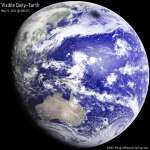 Looking Back at an Eclipsed Earth
30.05.2012
What's that dark spot on planet Earth? It's the shadow of the Moon. The above image of Earth was taken last week by MTSAT during an annular eclipse of the Sun. The dark spot appears quite unusual as clouds are white and the oceans are blue in this color corrected image.
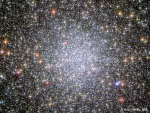 Globular Star Cluster 47 Tuc
18.05.2015
Globular star cluster 47 Tucanae is a jewel box of the southern sky. Also known as NGC 104, it roams the halo of our Milky Way Galaxy along with over 150 other globular star clusters.
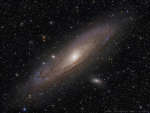 Andromeda Island Universe
29.04.2020
The most distant object easily visible to the unaided eye is M31, the great Andromeda Galaxy some two and a half million light-years away. But without a telescope, even this immense spiral galaxy - spanning over 200,000 light years - appears as a faint, nebulous cloud in the constellation Andromeda.
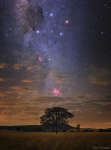 Carina in Perspective
4.05.2020
You need to be in the south, looking south, to see such a sky. And only then if you're lucky. Just above the picturesque tree is the impressive Carina Nebula, one of the few nebulas in the sky that is visible to the unaided eye.
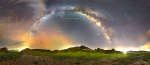 Perseids Around the Milky Way
16.08.2020
Why would meteor trails appear curved? The arcing effect arises only because the image artificially compresses (nearly) the whole sky into a rectangle. The meteors are from the Perseid Meteor Shower that peaked last week.
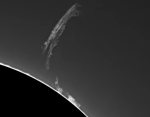 A Filament Leaps from the Sun
7.11.2021
Why, sometimes, does part of the Sun's atmosphere leap into space? The reason lies in changing magnetic fields that thread through the Sun's surface. Regions of strong surface magnetism, known as active regions, are usually marked by dark sunspots.
 APOD: 2024 February 27 Б Supernova Remnant Simeis 147
26.02.2024
It's easy to get lost following the intricate, looping, and twisting filaments of supernova remnant Simeis 147. Also cataloged as Sharpless 2-240, the filamentary nebula goes by the popular nickname the Spaghetti Nebula.
 APOD: 2024 May 11 Б AR 3664: Giant Sunspot Group
10.05.2024
Right now, one of the largest sunspot groups in recent history is crossing the Sun. Active Region 3664 is not only big -- it's violent, throwing off clouds of particles into the Solar System. Some of these CMEs are already impacting the Earth, and others might follow.
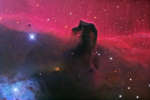 The Horsehead Nebula in Orion
25.11.2008
One of the most identifiable nebulae in the sky, the Horsehead Nebula in Orion, is part of a large, dark, molecular cloud. Also known as Barnard 33, the unusual shape was first discovered on a photographic plate in the late 1800s.
|
January February March April May June July August September |
|||||||||||||||||||||||||||||||||||||||||||||||||