
|
You entered: clouds
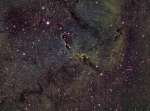 The Elephant s Trunk in IC 1396
26.12.2008
(xxxedit and linkxxx) Like an illustration in a galactic Just So Story, the Elephant's Trunk Nebula winds through the emission nebula and young star cluster complex IC 1396, in the high and far off constellation of Cepheus. Of course, this cosmic elephant's trunk is over 20 light-years long.
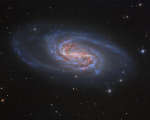 NGC 2903: A Missing Jewel in Leo
10.04.2015
Barred spiral galaxy NGC 2903 is only some 20 million light-years distant. Popular among amateur astronomers, it shines in the northern spring constellation Leo, near the top of the lion's head. That part of the constellation is sometimes seen as a reversed question mark or sickle.
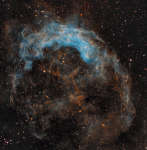 Windblown NGC 3199
6.05.2021
NGC 3199 lies about 12,000 light-years away, a glowing cosmic cloud in the nautical southern constellation of Carina. The nebula is about 75 light-years across in this narrowband, false-color view. Though the deep...
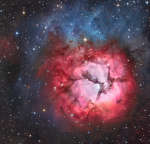 A Beautiful Trifid
12.08.2021
The beautiful Trifid Nebula is a cosmic study in contrasts. Also known as M20, it lies about 5,000 light-years away toward the nebula rich constellation Sagittarius. A star forming region in the plane...
 LDN 1622: Dark Nebula in Orion
22.01.2026
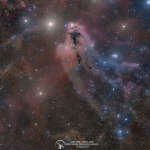
The silhouette of an intriguing dark nebula inhabits this cosmic scene. Lynds' Dark Nebula (LDN) 1622 appears against a faint background of glowing hydrogen gas only visible in long telescopic exposures of the region. In contrast, a brighter reflection nebula, vdB 62, is more easily seen just above the dusty dark nebula.
 APOD: 2026 March 10 Б Sky Glows over Paranal Observatory
10.03.2026
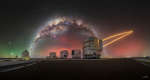
Are lasers from giant telescopes being used to defend the Earth? No. Lasers shot from telescopes are now commonly used to help increase the accuracy of astronomical observations. In some directions, Earth atmosphere-induced fluctuations in starlight can indicate how the air mass over a telescope is changing, but in other directions, no bright star exists.
 Jupiter s Great X Ray Spot
1.03.2002
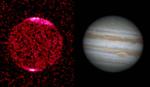
The Solar System's largest planet, gas giant Jupiter, is famous for its swirling Great Red Spot. In the right hand panel above, the familiar giant planet with storm system and cloud bands is shown in an optical image from the passing Cassini spacecraft.
 NGC 4631: The Whale Galaxy
23.01.2004
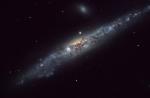
NGC 4631 is a big beautiful spiral galaxy seen edge-on only 25 million light-years away towards the small northern constellation Canes Venatici. This galaxy's slightly distorted wedge shape suggests to some a cosmic herring and to others the popular moniker of The Whale Galaxy.
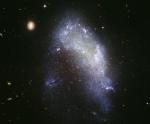 NGC 1427A: Galaxy in Motion
4.03.2005
In this tantalizing image, young blue star clusters and pink star-forming regions abound in NGC 1427A, a galaxy in motion. The small irregular galaxy's swept back outline points toward the top of this...
 G21.5-0.9: A Supernova s Cosmic Shell
21.04.2005
The picture is lovely, but this pretty cosmic shell was produced by almost unbelievable violence - created when a star with nearly 20 times the mass of the sun blasted away its outer layers in a spectacular supernova explosion.
|
January February March April May June July August September |
|||||||||||||||||||||||||||||||||||||||||||||||||