
|
You entered: stars
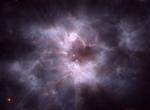 NGC 2440: Cocoon of a New White Dwarf
30.07.2000
Like a butterfly, a white dwarf star begins its life by casting off a cocoon that enclosed its former self. In this analogy, however, the Sun would be a caterpillar and the ejected shell of gas would become the prettiest of all!
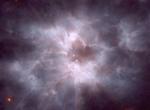 NGC 2440: Cocoon of a New White Dwarf
5.08.2001
Like a butterfly, a white dwarf star begins its life by casting off a cocoon that enclosed its former self. In this analogy, however, the Sun would be a caterpillar and the ejected shell of gas would become the prettiest of all!
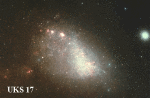 The Small Cloud of Magellan
19.07.1997
The southern sky contains wonders almost unknown in the north. These wonders include the Large and Small Magellanic Clouds: small irregular galaxies orbiting our own larger Milky Way spiral galaxy. The Small Magellanic Cloud (SMC), pictured here, is about 250,000 light years away.
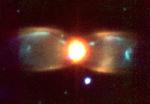 The Butterfly Planetary Nebula
21.10.1997
As stars age, they throw off their outer layers. Sometimes a highly symmetric gaseous planetary nebula is created, as is the case in M2-9, also called the Butterfly. Most planetary nebulae show this bipolar appearance, although some appear nearly spherical.
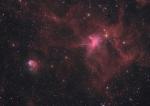 The Spider and The Fly
27.10.2006
Star clusters and nebulae abound in the ancient northern constellation Auriga - a region that includes the interesting pair NGC 1931 (lower left) and IC 417. In this gorgeous color image, an imaginative eye toward the expansive IC 417 and diminutive NGC 1931 suggests a cosmic spider and fly.
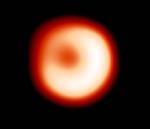 LkHa101: The Hole in the Doughnut
2.03.2001
You'd need a really big cup of coffee with this doughnut ... because the hole in the middle is about a billion kilometers across. Centered on the Sun, a circle that size would lie between the orbits of Mars and Jupiter.
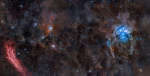 Seven Sisters Versus California
3.11.2009
On the upper right, dressed in blue, is the Pleiades. Also known as the Seven Sisters and M45, the Pleiades is one of the brightest and most easily visible open clusters on the sky. The Pleiades contains over 3,000 stars, is about 400 light years away, and only 13 light years across.
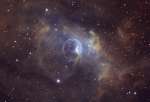 The Bubble Nebula
2.09.2010
Blown by the wind from a massive star, this interstellar apparition has a surprisingly familiar shape. Cataloged as NGC 7635, it is also known simply as The Bubble Nebula. Although it looks delicate, the 10 light-year diameter bubble offers evidence of violent processes at work.
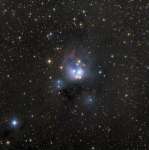 Young Suns of NGC 7129
4.09.2010
Young suns still lie within dusty NGC 7129, some 3,000 light-years away toward the royal constellation Cepheus. While these stars are at a relatively tender age, only a few million years old, it is likely that our own Sun formed in a similar stellar nursery some five billion years ago.
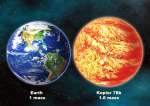 Kepler 78b: Earth Sized Planet Discovered
5.11.2013
Even though Kepler-78b is only slightly larger than the Earth, it should not exist. Its size is extraordinary only in the sense that it is the most similar in size to the Earth of any exoplanet yet directly discovered.
|
January February March April May June July August September |
|||||||||||||||||||||||||||||||||||||||||||||||||