
|
You entered: constellation
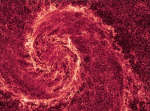 The Whirlpool Galaxy in Infrared Dust
26.01.2011
How do spiral galaxies form stars? To help find out, the Hubble Space Telescope imaged the nearby photogenic spiral M51 in infrared light to highlight the dust that traces the dense gas that best forms stars. To further isolate the dust, much of the optical light from stars has also been digitally removed.
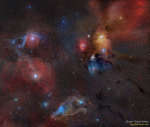 Rho Ophiuchi Wide Field
27.07.2014
The clouds surrounding the star system Rho Ophiuchi compose one of the closest star forming regions. Rho Ophiuchi itself is a binary star system visible in the light-colored region on the image right.
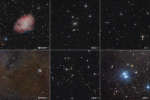 Catalog Entry Number 1
15.03.2018
Every journey has first step and every catalog a first entry. First entries in six well-known deep sky catalogs appear in these panels, from upper left to lower right in chronological order of original catalog publication.
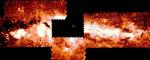 Galactic Centre Starscape
29.06.2000
Thirty thousand light-years distant, beyond the majestic dust clouds of the constellation Sagittarius, lies the centre of our Milky Way Galaxy. Hidden from optical view by the dust, the Galactic Centre region is a relatively unexplored starscape.
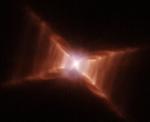 Rungs of the Red Rectangle
13.05.2004
A distinctive X-shape and ladder-like rungs appear in this Hubble Space Telescope image of the intriguing Red Rectangle Nebula. The dusty cosmic cloud was originally identified as a strong source of infrared radiation and is now believed to contain icy dust grains and hydrocarbon molecules formed in the cool outflow from an aging central star.
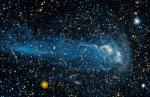 The Tail of a Wonderful Star
17.08.2007
To seventeenth century astronomers, Omicron Ceti or Mira was known as a wonderful star, a star whose brightness could change dramatically in the course of about 11 months. Mira is now seen as the archetype of an entire class of long-period variable stars.
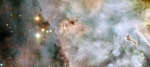 Massive Stars Resolved in the Carina Nebula
1.12.2008
How massive can stars be? Big, hefty stars live short violent lives that can profoundly affect their environments. Isolating a massive star can be problematic, however, since what seems to be a single bright star might actually turn out to be several stars close together.
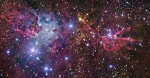 Fox Fur, a Unicorn, and a Christmas Tree
25.12.2008
Clouds of glowing hydrogen gas fill this colorful skyscape in the faint but fanciful constellation Monoceros, the Unicorn. A star forming region cataloged as NGC 2264, the complex jumble of cosmic gas and dust...
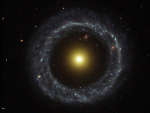 Hoags Object: A Strange Ring Galaxy
28.07.2013
Is this one galaxy or two? This question came to light in 1950 when astronomer Art Hoag chanced upon this unusual extragalactic object. On the outside is a ring dominated by bright blue stars, while near the center lies a ball of much redder stars that are likely much older.
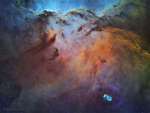 NGC 6188: Dragons of Ara
7.06.2022
Do dragons fight on the altar of the sky? Although it might appear that way, these dragons are illusions made of thin gas and dust. The emission nebula NGC 6188, home to the glowing...
|
January February March April May June July August |
||||||||||||||||||||||||||||||||||||||||||||||||||||||||