
|
You entered: image
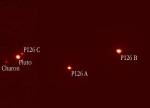 Pluto and Charon Eclipse a Triple Star
11.09.2002
Occasionally, a planet in our Solar System will pass in front of a bright star. Since stars and planets take up so little space on the sky, such events are quite rare. Two months ago, however, Pluto and its large moon Charon passed in front of a comparatively bright triple star system known as P126.
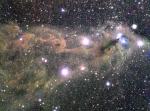 Star Clouds Toward the Southern Crown
2.10.2002
The flowing trails of dust toward Corona Australis, the constellation of the Southern Crown, are visible here because not because they glow, but because they absorb and reflect. The dust appears bluer when seen near bright stars because it preferentially reflects blue light.
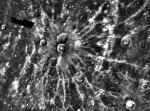 Degas Ray Crater on Mercury
8.12.1996
Like the Earth's Moon, Mercury is scarred with craters, testifying to an intense bombardment during the early history of the Solar System. In 1974, the Mariner 10 spacecraft surveyed this innermost planet up close, producing the only detailed images of its tortured surface.
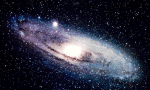 M31: The Andromeda Galaxy
1.11.1997
Andromeda is the nearest major galaxy to our own Milky Way Galaxy. Our Galaxy is thought to look much like Andromeda. Together these two galaxies dominate the Local Group of galaxies. The diffuse light from Andromeda is caused by the hundreds of billions of stars that compose it.
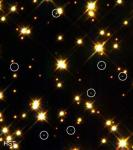 White Dwarf Stars Cool
2.11.1997
Diminutive by stellar standards, white dwarf stars are also intensely hot ... but they are cooling. No longer do their interior nuclear fires burn, so they will continue to cool until they fade away. This Hubble Space Telescope image covers a small region near the center of a globular cluster known as M4.
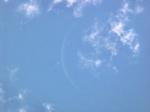 Crescent Venus and Moon
30.10.2006
There's something behind these clouds. Those faint graceful arcs, upon inspection, are actually far, far in the distance. They are the Earth's Moon and the planet Venus. Both the Moon and Venus are bright enough to be seen during the day, and both are quite capable of showing a crescent phase.
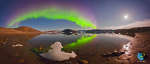 Aurora Over Greenland
23.08.2011
This aurora arched from horizon to horizon. During the current Shelios expedition to observe and learn about the northern lights, the sky last weekend did not disappoint. After sunset and some careful photographic planning, the above image was taken from the expedition's Qaleraliq campsite in southern Greenland.
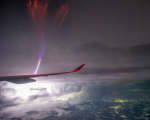 Gigantic Jet Lightning over India
18.09.2019
Yes, but can your lightning bolt do this? While flying from Munich to Singapore earlier this month, an industrious passenger took images of a passing lightning storm and caught something unexpected: gigantic jet lightning. The jet was captured on a single 3.2-second exposure above Bhadrak, India.
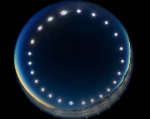 Eclipse on a Polar Day
10.12.2021
During polar day, in Arctic and Antarctic summer, the Sun stays above the horizon for periods of 24 hours or more. Recorded on December 4, this fisheye timelapse image tracks the Sun in multiple frames as it completes a circle in the summer sky above Union Glacier, Antarctica.
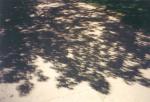 The Eclipse Tree
25.12.2000
If you look closely at the shadow of this tree, you will see something quite unusual: it is composed of hundreds of images of a partially eclipsed Sun. Early today, trees across North America will be casting similar shadows as a partial eclipse of the Sun takes place.
|
January February March April May June July August September |
|||||||||||||||||||||||||||||||||||||||||||||||||