
|
You entered: supernova
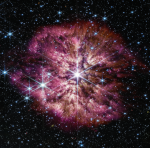 Wolf Rayet 124
17.03.2023
Driven by powerful stellar winds, expanding shrouds of gas and dust frame hot, luminous star Wolf-Rayet 124 in this sharp infrared view. The eye-catching 6-spike star pattern is characteristic of stellar images made with the 18 hexagonal mirrors of the James Webb Space Telescope.
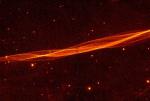 Filaments In The Cygnus Loop
26.04.2000
Subtle and delicate in appearance, these are filaments of shocked interstellar gas -- part of the expanding blast wave from a violent stellar explosion. Recorded in November 1997 with the Wide Field and Planetary Camera 2 onboard the Hubble Space Telescope, the picture is a closeup of a supernova remnant known as the Cygnus Loop.
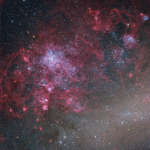 The Tarantula Zone
12.06.2014
The Tarantula Nebula is more than 1,000 light-years in diameter, a giant star forming region within our neighboring galaxy the Large Magellanic Cloud (LMC). That cosmic arachnid lies toward the upper left in this deep and colorful telescopic view made through broad-band and narrow-band filters.
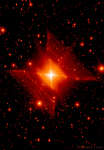 The Red Square Nebula
25.09.2021
How did a round star create this square nebula? No one is quite sure. The round star, known as MWC 922 and possibly part of a multiple star system, appears at the center of the Red Square Nebula. The featured image combines infrared exposures from the Hale Telescope on Mt.
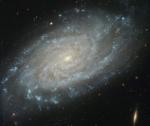 NGC 3370: A Sharper View
11.09.2003
Similar in size and grand design to our own Milky Way, spiral galaxy NGC 3370 lies about 100 million light-years away toward the constellation Leo. Recorded here in exquisite detail by the Hubble Space...
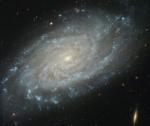 NGC 3370: A Sharper View
14.05.2005
Similar in size and grand design to our own Milky Way, spiral galaxy NGC 3370 lies about 100 million light-years away toward the constellation Leo. Recorded here in exquisite detail by the Hubble Space...
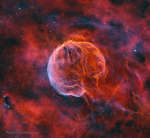 APOD: 2026 January 19 Б CTB 1: The Medulla Nebula
18.01.2026
What powers this unusual nebula? CTB 1 is the expanding gas shell that was left when a massive star toward the constellation of Cassiopeia exploded about 10,000 years ago. The star likely detonated when it ran out of elements, near its core, that could create stabilizing pressure with nuclear fusion.
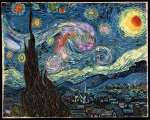 Starry Night Scavenger Hunt
15.06.2010
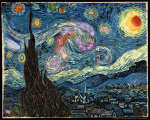
Did you know that Van Gogh's painting Starry Night includes Comet Hale-Bopp? Hopefully not, because it doesn't. But the above image does. Although today's featured picture may appear at first glance...
 Starry Night Scavenger Hunt
17.09.2016
Did you know that van Gogh's painting Starry Night includes Comet Hale-Bopp? Hopefully not, because it doesn't. But the featured image does. Although today's picture may appear at first glance...
 Filaments of the Cygnus Loop
27.09.2020
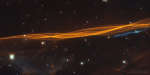
What lies at the edge of an expanding supernova? Subtle and delicate in appearance, these ribbons of shocked interstellar gas are part of a blast wave at the expanding edge of a violent stellar explosion that would have been easily visible to humans during the late stone age, about 20,000 years ago.
|
January February March April May June July August September October |
|||||||||||||||||||||||||||||||||||||||||||||||||