
|
You entered: night sky
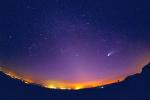 A Fisheye View of Comet Hale-Bopp
25.08.1997
Thousands of stars, several constellations, a planet and a comet all graced the western horizon over Ujue, Spain just after sunset on April 4th, 1997. Because the picture was taken with a fisheye lens, much of the whole night sky is visible. Comet Hale-Bopp, with both tails blazing, appears right of center.
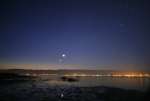 Venus and Jupiter in Morning Skies
2.02.2008
These two celestial beacons shining brightly in the east before sunrise are actually children of the Sun, the planets Venus and Jupiter. The second and third brightest objects in the sky at Night after...
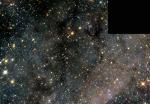 A Magellanic Starfield
4.01.2003
Stars of many types and colors are visible in this Hubble Space Telescope close-up of a starfield in the Large Magellanic Cloud (LMC). Over 10,000 stars are visible -- the brightest of which are giant stars. Were our Sun at the distance of these stars, about 170,000 light-years, it would hardly be discernable.
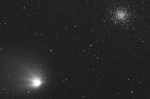 Comet Hale-Bopp Passes M14
12.11.1996
Comet Hale-Bopp continues its slow trek across the night sky, and can now be seen superposed near the bright globular cluster M14. Will Comet Hale-Bopp become as bright in early 1997 as Comet Hyakutake did in early 1996? It is still too early to tell.
 Moon Over Shiraz
13.11.2004
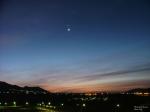
Early morning risers around the world have enjoyed the sight of bright planets in this week's predawn skies - further enhanced by the celestial spectacle of the waning crescent Moon. From some locations the Moon was seen to pass in front of Jupiter or Venus, a lunar occultation.
 Geminid Fireball over Mount Balang
16.12.2014
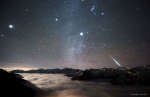
This was a sky to remember. While viewing the Geminids meteor shower a few days ago, a bright fireball was captured over Mt. Balang, China with particularly picturesque surroundings. In the foreground, a sea of light clouds slowly floated between dark mountain peaks.
 The Milky Way Through the Summer Triangle
12.12.1996
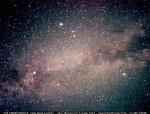
There are more than a few stars in our Galaxy. The light from many of them combines to appear as a wisp of faint light across the night sky - the Milky Way.
 Real Time Perseid
8.09.2018
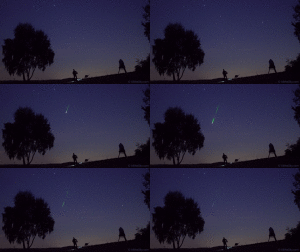
Bright meteors and dark night skies made this year's Perseid meteor shower a great time for a weekend campout. And while packing away their equipment, skygazers at a campsite in the mountains...
 Heaven on Earth
6.11.2000
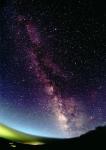
If sometimes it appears that the entire Milky Way Galaxy is raining down on your head, do not despair. It happens twice a day. As the Sun rises in the East, wonders of the night sky become less bright than the sunlight scattered by our own Earth's atmosphere, and so fade from view.
 Just Passing Through
25.08.2007
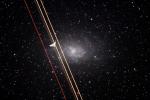
M33 is a big, beautiful spiral galaxy a mere 3 million light-years away, understandably a popular target for enthusiastic astro-imagers. Just as understandably, interfering satellite trails and airplane streaks that are becoming more common in planet Earth's busy night sky are processed out of their finished images.
|
January February March April May June July August September |
|||||||||||||||||||||||||||||||||||||||||||||||||