
|
You entered: nearest stars
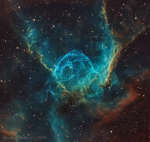 Thors Helmet
20.07.2021
Thor not only has his own day (Thursday), but a helmet in the heavens.б Popularly called Thor's Helmet, NGC 2359 is a hat-shaped cosmic cloud with wing-like appendages. Heroically sized even for a Norse god, Thor's Helmet is about 30 light-years across.
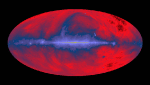 The Radio Sky: Tuned to 408MHz
26.11.1996
Tune your radio telescope to 408MHz (408 million cycles per second) and check out the Radio Sky! You should find that frequency on your dial somewhere between US broadcast television channels 13 and 14.
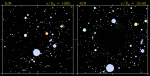 Too Close to a Black Hole
8.09.2002
What would you see if you went right up to a black hole? Above are two computer generated images highlighting how strange things would look. On the left is a normal star field containing the constellation Orion. Notice the three stars of nearly equal brightness that make up Orion's Belt.
 The Star Trails of Kilimanjaro
7.03.2003
The night had no moon, but the stars were out. And camped at 16,000 feet on Mt. Kilimanjaro, photographer Dan Heller recorded this marvelous 3 1/2 hour long exposure. Here the landscape is lit mostly by the stars.
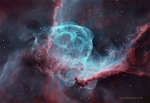 APOD: 2026 June 9 Б Thors Helmet
9.06.2026
Thor not only has his own day (Thursday), but a helmet in the heavens. Popularly called Thor's Helmet, NGC 2359 is a hat-shaped cosmic cloud with wing-like appendages. Heroically sized even for a Norse god, Thor's Helmet is about 30 light-years across.
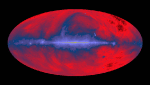 The Radio Sky: Tuned to 408MHz
14.12.1997
Tune your radio telescope to 408MHz (408 million cycles per second) and check out the Radio Sky! You should find that frequency on your dial somewhere between US broadcast television channels 13 and 14.
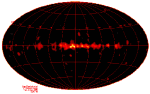 COMPTEL Explores The Radioactive Sky
24.07.1996
Diffuse gas clouds laced with radioactive aluminum atoms (Al26) line the plane of our Milky Way Galaxy! How do we see them? Relying on the Compton Effect, the COMPTEL instrument onboard NASA's immense orbiting Compton Gamma Ray Observatory can "see" the 1.8 million electron Volt gamma rays emitted by the radioactive decay.
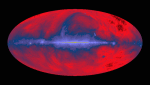 The Radio Sky: Tuned to 408MHz
3.04.1999
Tune your radio telescope to 408MHz (408 million cycles per second) and check out the Radio Sky! You should find that frequency on your dial somewhere between US broadcast television channels 13 and 14.
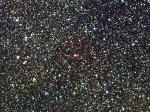 Proxima Centauri: The Closest Star
4.12.2005
What is the closest star to our Sun? It is Proxima Centauri, the nearest member of the Alpha Centauri triple star system. Light takes only 4.22 years to reach us from Proxima Centauri. This...
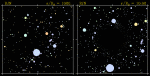 Too Close to a Black Hole
10.12.2000
What would you see if you went right up to a black hole? Above are two computer generated images highlighting how strange things would look. On the left is a normal star field containing the constellation Orion. Notice the three stars of nearly equal brightness that make up Orion's Belt.
|
January February March April May June July August September October |
|||||||||||||||||||||||||||||||||||||||||||||||||