
|
You entered: hot star
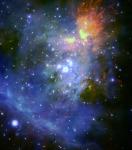 The Orion Nebula from Subaru
2.02.1999
The Orion Nebula (M42) shows a host of treasures when viewed in infrared light. Some stars in the Trapezium, an open cluster of stars at the center, are only visible in infrared light. The orange feature above center is called the Kleinman-Low Nebula, and appears greatly affected by newly forming central star IRc2.
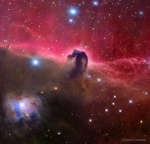 The Magnificent Horsehead Nebula
13.05.2015
Sculpted by stellar winds and radiation, a magnificent interstellar dust cloud by chance has assumed this recognizable shape. Fittingly named the Horsehead Nebula, it is some 1,500 light-years distant, embedded in the vast Orion cloud complex.
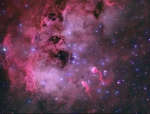 The Tadpoles of IC 410
13.11.2015
This telescopic close-up shows off the otherwise faint emission nebula IC 410. It also features two remarkable inhabitants of the cosmic pond of gas and dust below and right of center, the tadpoles of IC 410. Partly obscured by foreground dust, the nebula itself surrounds NGC 1893, a young galactic cluster of stars.
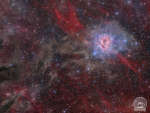 Cocoon Nebula Deep Field
19.09.2018
Inside the Cocoon Nebula is a newly developing cluster of stars. The cosmic Cocoon on the upper right also punctuates a long trail of obscuring interstellar dust clouds to its left. Cataloged...
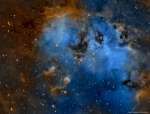 The Tadpoles of IC 410
24.01.2018
This telescopic close-up shows off the otherwise faint emission nebula IC 410. It also features two remarkable inhabitants of the cosmic pond of gas and dust below and left of center, the tadpoles of IC 410. Partly obscured by foreground dust, the nebula itself surrounds NGC 1893, a young galactic cluster of stars.
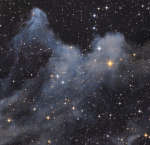 The Ghoul of IC 2118
29.10.2020
Inspired by the halloween season, this telescopic portrait captures a cosmic cloud with a scary visage. The interstellar scene lies within the dusty expanse of reflection nebula IC 2118 in the constellation Orion. IC 2118 is about 800 light-years from your neighborhood, close to bright bluish star Rigel at the foot of Orion.
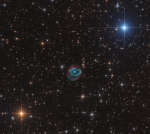 Planetary Nebula Abell 78
16.10.2020
Planetary nebula Abell 78 stands out in this colorful telescopic skyscape. In fact the colors of the spiky Milky Way stars depend on their surface temperatures, both cooler (yellowish) and hotter (bluish) than the Sun.
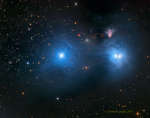 Stars and Dust in Corona Australis
20.09.2018
Cosmic dust clouds and young, energetic stars inhabit this telescopic vista, less than 500 light-years away toward the northern boundary of Corona Australis, the Southern Crown. The dust clouds effectively block light from more distant background stars in the Milky Way.
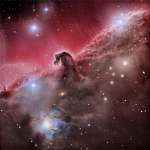 The Magnificent Horsehead Nebula
13.05.2010
Sculpted by stellar winds and radiation, a magnificent interstellar dust cloud by chance has assumed this recognizable shape. Fittingly named the Horsehead Nebula, it is some 1,500 light-years distant, embedded in the vast Orion cloud complex.
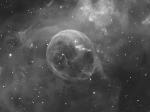 NGC 7635: The Bubble
18.10.2006
What created this huge space bubble? Blown by the wind from a star, this tantalizing, ghostly apparition is cataloged as NGC 7635, but known simply as The Bubble Nebula. Astronomer Eric Mouquet's striking view utilizes a long exposure with hydrogen alpha light to reveal the intricate details of this cosmic bubble and its environment.
|
January February |
|||||||||||||||||||||||||||||||||||||||||||||||||