
|
You entered: constellation
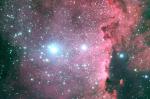 Hot Stars in the Southern Milky Way
7.05.1999
Hot blue stars, red glowing hydrogen gas, and dark, obscuring dust clouds are strewn through this dramatic region of the Milky Way in the southern constellation of Ara (the Altar). About 4,000 light-years from Earth, the stars at the left are young, massive, and energetic.
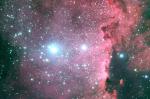 Hot Stars in the Southern Milky Way
21.12.2001
Hot blue stars, red glowing hydrogen gas, and dark, obscuring dust clouds are strewn through this dramatic region of the Milky Way in the southern constellation of Ara (the Altar). About 4,000 light-years from Earth, the stars at the left are young, massive, and energetic.
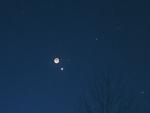 Moon, Mars, Venus, and Spica
3.12.2002
Gliding toward today's total eclipse of the Sun, the crescent Moon has been rising early, just before dawn. And as a prelude to its close solar alignment, the Moon also completed a lovely celestial triangle, closing with bright planets Mars and Venus on the morning of December 1.
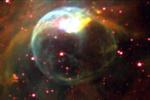 NGC 7635: The Bubble Nebula
16.11.1998
What created this huge space bubble? A massive star that is not only bright and blue, but also emitting a fast stellar wind of ionized gas. The Bubble Nebula is actually the smallest...
 Mars Over the Allalinhorn
7.03.2010
What's that bright object in the sky? A common question with answers that vary by time and season, the quick answer just after sunset in middle of last month, from the norther hemisphere, was Mars.
 The Fox Fur Nebula
29.12.2015
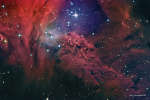
This interstellar canine is formed of cosmic dust and gas interacting with the energetic light and winds from hot young stars. The shape, visual texture, and color, combine to give the region the popular name Fox Fur Nebula.
 Reflections of the Ghost Nebula
25.10.2020
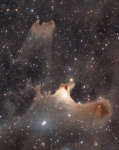
Do any shapes seem to jump out at you from this interstellar field of stars and dust? The jeweled expanse, filled with faint, starlight-reflecting clouds, drifts through the night in the royal constellation of Cepheus.
 Regulus Occulted
2.08.1999
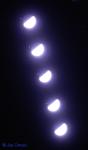
On May 21, viewed from the continental US, a star winked out as it passed behind the dark limb of the first-quarter Moon. The star, Regulus, is hotter than the sun, about 69 light-years distant, and shines in Earth's skies as the brightest star in the constellation Leo, the Lion.
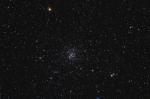 Star Cluster Messier 67
9.08.2007
Gathered at the center of this sharp skyview are the stars of Messier 67, one of the oldest known open star clusters. In fact, though open star clusters are usually much younger, the stars...
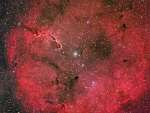 Emission Nebula IC 1396
23.12.2007
Sprawling across hundreds of light-years, emission nebula IC 1396 mixes glowing cosmic gas and dark dust clouds. Stars are forming in this area, only about 3,000 light-years from Earth. This detailed view...
|
January February |
|||||||||||||||||||||||||||||||||||||||||||||||||