
|
You entered: active region
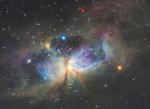 Star Forming Region S106
20.02.2001
Massive star IRS4 is beginning to spread its wings. Born only about 100,000 years ago, material streaming out from this newborn star has formed the nebula dubbed Sharpless 106 Nebula (S106), pictured above.
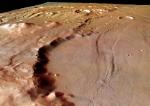 Crater Wall on Solis Planum
30.09.2004
This dramatic perspective view looks south-east along the wall of a large eroded impact crater on Solis Planum, bordering the mountainous Thaumasia region of Mars. Stretching for about 50 kilometers into the scene, the crater wall is around 800 meters high.
 Starburst Galaxy Messier 94
6.03.2025
Beautiful island universe Messier 94 lies a mere 15 million light-years distant in the northern constellation of the hunting dogs, Canes Venatici. A popular target for earth-based astronomers, the face-on spiral galaxy is about 30,000 light-years across, with spiral arms sweeping through the outskirts of its broad disk.
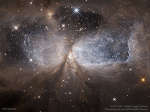 Star Forming Region S106
16.02.2016
Massive star IRS 4 is beginning to spread its wings. Born only about 100,000 years ago, material streaming out from this newborn star has formed the nebula dubbed Sharpless 2-106 Nebula (S106), featured here.
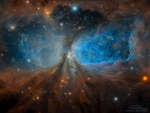 Star Forming Region S106
25.03.2020
Massive star IRS 4 is beginning to spread its wings. Born only about 100,000 years ago, material streaming out from this newborn star has formed the nebula dubbed Sharpless 2-106 Nebula (S106), featured here.
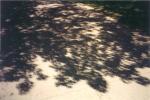 Eclipse In The Shade
13.08.1999
Near the shadow of the moon under a shady tree, dozens of images of a 1994 solar eclipse in progress are visible in this striking picture from the campus of Northwestern University in Evanston, Illinois. What creates the multiple images?
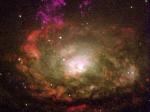 The Circinus Galaxy
4.12.2000
Powerful forces are at play in the nearby Circinus Galaxy. Hot gas, colored pink, is being ejected out of the spiral galaxy from the central region. Much of Circinus' tumultuous gas, however, is concentrated in two rings.
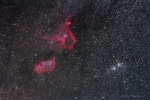 Heart and Soul and Double Cluster
24.09.2016
This rich starfield spans almost 10 degrees across the sky toward the northern constellations Cassiopeia and Perseus. On the left, heart-shaped cosmic cloud IC 1805 and IC 1848 are popularly known as the Heart and Soul nebulae.
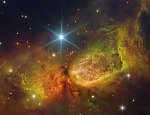 Star Forming Region S106
7.11.2011
Massive star IRS 4 is beginning to spread its wings. Born only about 100,000 years ago, material streaming out from this newborn star has formed the nebula dubbed Sharpless 2-106 Nebula (S106), pictured above.
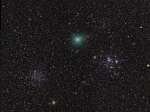 The Comet Hartley 2 Cruise
7.10.2011
Early last November, small but active Comet Hartley 2 (103/P Hartley) became the fifth comet imaged close-up by a spacecraft from planet Earth. Still cruising through the solar system with a 6 year orbital period, Hartley 2 is is making astronomical headlines again, though.
|
January February March April May June July August September |
|||||||||||||||||||||||||||||||||||||||||||||||||