
|
You entered: outer Galaxy
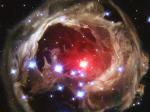 Light Echoes from V838 Mon
26.11.2005
What caused this outburst of V838 Mon? For reasons unknown, star V838 Mon's outer surface suddenly greatly expanded with the result that it became the brightest star in the entire Milky Way Galaxy in January 2002. Then, just as suddenly, it faded.
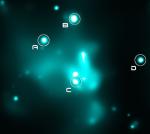 The Swarm
29.07.2006
What do you call a group of black holes ... a flock, a brace, a swarm? Monitoring a region around the center of our Galaxy, astronomers have indeed found evidence for a surprisingly large number...
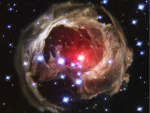 Light Echoes from V838 Mon
2.02.2008
What caused this outburst of V838 Mon? For reasons unknown, star V838 Mon's outer surface suddenly greatly expanded with the result that it became the brightest star in the entire Milky Way Galaxy in January 2002. Then, just as suddenly, it faded.
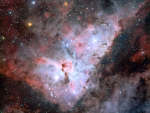 The Great Carina Nebula
15.02.2009
A jewel of the southern sky, the Great Carina Nebula, aka NGC 3372, spans over 300 light-years, one of our Galaxy's largest star forming regions. Like the smaller, more northerly Great Orion Nebula...
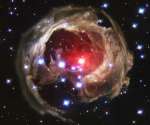 Light Echoes from V838 Mon
21.11.2009
What caused this outburst of V838 Mon? For reasons unknown, star V838 Mon's outer surface suddenly greatly expanded with the result that it became the brightest star in the entire Milky Way Galaxy in January 2002. Then, just as suddenly, it faded.
 Chasing Carina
25.02.2010
A jewel of the southern sky, the Great Carina Nebula, aka NGC 3372, spans over 300 light-years. Near the upper right of this expansive skycape, it is much larger than the more northerly Orion Nebula.
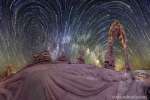 Warped Sky: Star Trails over Arches National Park
17.03.2014
What's happened to the sky? A time warp, of sorts, and a digital space warp too. The time warp occurs because this image captured in a single frame a two and a half hour exposure of the night sky. As a result, prominent star trails are visible.
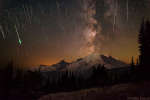 Meteors and Milky Way over Mount Ranier
24.08.2015
Despite appearances, the sky is not falling. Two weeks ago, however, tiny bits of comet dust were. Featured here is the Perseids meteor shower as captured over Mt. Rainier, Washington, USA. The image was created from a two-hour time lapse video, snaring over 20 meteors, including one that brightened dramatically on the image left.
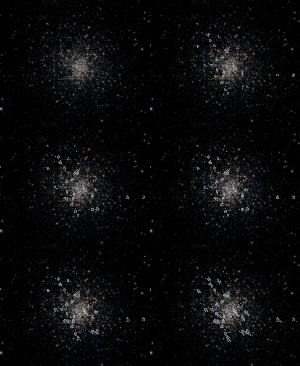 The Gaia Stars of M15
27.03.2019
Messier 15 is a 13 billion year old relic of the early formative years of our galaxy, one of about 170 globular star clusters that still roam the halo of the Milky Way. About 200 light-years in diameter, it lies about 35,000 light years away toward the constellation Pegasus.
 APOD: 2025 September 10 Б The Great Lacerta Nebula
9.09.2025
It is one of the largest nebulas on the sky -- why isn't it better known? Roughly the same angular size as the Andromeda Galaxy, the Great Lacerta Nebula can be found toward the constellation of the Lizard (Lacerta).
|
January February March April May June July August September |
|||||||||||||||||||||||||||||||||||||||||||||||||