
|
You entered: NASA
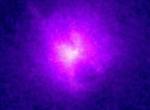 Hot Gas In Hydra A
17.12.1999
The Hydra A galaxy cluster is really big. In fact, such clusters of galaxies are the largest gravitationally bound objects in the Universe. But individual galaxies are too cool to be recorded in this false-color Chandra Observatory X-ray image which shows only the 40 million degree gas that permeates the Hydra A cluster.
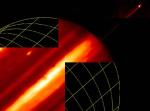 Jupiter: Moon, Ring, and Clouds
21.11.1997
An inner moon, an edge-on, planet-girdling ring, and high altitude cloud bands are visible in this mosaic of infrared images of gas giant Jupiter. The moon Metis, 25 miles wide and about 80,000 miles from the planet, is the bright spot at the upper right.
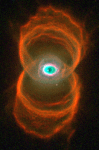 MyCn18: An Hourglass Nebula
18.01.1996
The sands of time are running out for the central star of this hourglass-shaped planetary nebula. With its nuclear fuel exhausted, this brief, spectacular, closing phase of a Sun-like star's life occurs as its outer layers are ejected - its core becoming a cooling, fading White Dwarf.
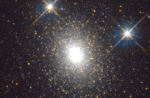 A Giant Globular Cluster in M31
26.04.1996
G1, pictured above, is the brightest known globular cluster in the whole Local Group of galaxies. Also called Mayall II, it orbits the center of the largest nearby galaxy: M31. G1 contains over 300,000 stars and is almost as old as the entire universe.
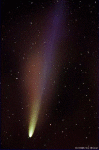 The Tails of Comet Hyakutake
2.05.1996
What makes comet tails so colorful? This photograph of Comet Hyakutake was taken the night of April 18th and highlights different components of the tail. The gold and red tail features are dust, made predominately of little bits of rock and carbon. The dust tail shines by reflecting sunlight.
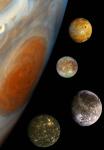 Jupiter And Family
29.09.1997
This composite image features classic portraits of members of one of the Solar System's most prominent families - Jupiter and its four large "Galilean" moons. Starting from the top the moons are Io, Europa, Ganymede, and Callisto. The top-to-bottom order is also the order of increasing distance from Jupiter.
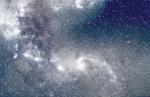 NGC4039: Starbirth and Galaxy Death
6.05.1997
Do star clusters form when galaxies collide? Quite possibly, according to Hubble Space Telescope observations of the "Antennae", two galaxies thought to be in the early stages of a collision.
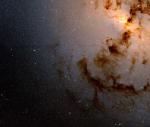 NGC 1316: After Galaxies Collide
22.02.1999
Astronomers turn detectives when trying to figure out the cause of unusual sites like NGC 1316. A preliminary inspection indicates that NGC 1316 is an enormous elliptical galaxy that started devouring a smaller spiral galaxy neighbor about 100 million years ago. Supporting evidence includes the dark dust lanes uniquely indicative of a spiral.
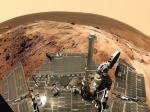 Vista Inside Gusev Crater on Mars
28.11.2005
What is the geologic history of Mars? To help find out, the robot Spirit rover explored the terrain on the way up to the top of Husband Hill and took pictures along the way.
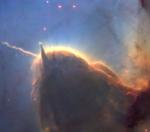 Trifid Pillars and Jets
8.06.1999
Dust pillars are like interstellar mountains. They survive because they are more dense than their surroundings, but they are being slowly eroded away by a hostile environment. Visible in the above picture...
|
January February March |
||||||||||||||||||||||||||||||||||||||||||||||||||||||||