
|
You entered: gas
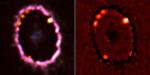 New Shocks For Supernova 1987A
17.02.2000
In February of 1987, astronomers witnessed the brightest supernova of modern times - supernova 1987A in the Large Magellanic Cloud. Mysterious rings of material surrounding the expanding stellar debris were soon emitting a visible glow excited by intense light from the explosion.
 APOD: 2023 October 10 Б Hidden Orion from Webb
10.10.2023
The Great Nebula in Orion has hidden stars. To the unaided eye in visible light, it appears as a small fuzzy patch in the constellation of Orion. But this image was taken by the Webb Space Telescope in a representative-color composite of red and very near infrared light.
 APOD: 2023 October 24 Б Arp 87: Merging Galaxies from Hubble
24.10.2023
This dance is to the death. As these two large galaxies duel, a cosmic bridge of stars, gas, and dust currently stretches over 75,000 light-years and joins them. The bridge itself is strong evidence that these two immense star systems have passed close to each other and experienced violent tides induced by mutual gravity.
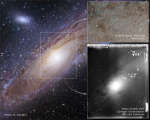 VAR
VAR
1.07.2011
In the 1920s, examining photographic plates from the Mt. Wilson Observatory's 100 inch telescope, Edwin Hubble determined the distance to the Andromeda Nebula, decisively demonstrating the existence of other galaxies far beyond the Milky Way.
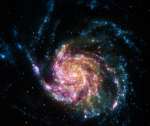 21st Century M101
13.07.2012
One of the last entries in Charles Messier's famous catalog, big, beautiful spiral galaxy M101 is definitely not one of the least. About 170,000 light-years across, this galaxy is enormous, almost twice the size of our own Milky Way Galaxy.
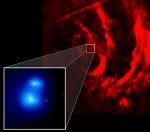 Around The Arches Cluster
14.06.2001
The most compact cluster of stars known in our galaxy, the Arches cluster, boasts 100 or so massive, young stars contained within a diameter of one light-year. Seen toward the constellation Sagittarius, the Arches...
 NGC 253: Close Up
19.05.2011
This dusty island universe is one of the brightest spiral galaxies in planet Earth's sky. Seen nearly edge-on, NGC 253 is only 13 million light-years away, the largest member of the Sculptor Group of galaxies, neighbor to our own local galaxy group.
 APOD: 2024 February 20 Б AM1054: Stars Form as Galaxies Collide
20.02.2024
When galaxies collide, how many stars are born? For AM1054-325, featured here in a recently released image by the Hubble Space Telescope, the answer is millions. Instead of stars being destroyed as galaxy AM1054-325 and a nearby galaxy circle each other, their gravity and motion has ignited stellar creation.
 New Stars In 30 Doradus
1.10.1999
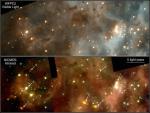
Compare these matched Hubble Space Telescope views (visible-light on top; infrared on bottom) of a region in the star-forming 30 Doradus Nebula. Find the numbered arrows in the infrared image which identify newborn massive stars. For example, arrows 1 and 5 both point to compact clusters of bright young stars.
 The Far 3kpc Arm
11.07.2008
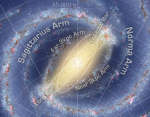
A major discovery was lurking in the data. By accident, while preparing a talk on the Galaxy's spiral arms for a meeting of the American Astronomical Society, Tom Dame (Harvard-Smithsonian CfA) found it - a new spiral arm in the Milky Way.
|
January February March April May |
|||||||||||||||||||||||||||||||||||||||||||||||||