
|
You entered: rings
 The Ghost of Jupiter s Halo
11.07.2019
Close-up images of NGC 3242 show the cast off shroud of a dying, sun-like star fancifully known as The Ghost of Jupiter nebula. But this deep and wide telescopic view also finds the seldom...
 Webb s Rho Ophiuchi
13.07.2023
A mere 390 light-years away, Sun-like stars and future planetary systems are forming in the Rho Ophiuchi molecular cloud complex, the closest star-forming region to our fair planet. The James Webb Space Telescope's NIRCam peered into the nearby natal chaos to capture this infrared image at an inspiring scale.
 Leonids Over Joshua Tree National Park
5.11.2002
This year's Leonid Meteor Shower is predicted to have two peaks, like last year's. The first peak should come at about 04:00 hours Universal Time (UT) on November 19 and be primarily visible from Western Europe before sunrise.
 The Orion Nebula from CFHT
15.03.2004
Few astronomical sights excite the imagination like the nearby stellar nursery known as the Orion Nebula. The Nebula's glowing gas surrounds hot young stars at the edge of an immense interstellar molecular cloud only 1500 light-years away.
 Islands of Four Mountains from Above
22.06.2010
Our Earth is covered by volcanoes. Volcanoes are breaks in the Earth's cool surface where hot liquid rock from the interior comes out -- sometimes suddenly. In the above image from the ASTER camera...
 Asteroids Near Earth
1.10.2011
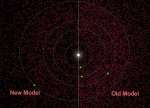
Though the sizes are not to scale, the Sun and planets of the inner solar system are shown in this illustration, where each red dot represents an asteroid. New results from NEOWISE, the infrared...
 MACS 1206: A Galaxy Cluster Gravitational Len
17.10.2011
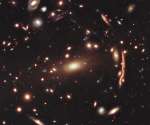
It is difficult to hide a galaxy behind a cluster of galaxies. The closer cluster's gravity will act like a huge lens, pulling images of the distant galaxy around the sides and greatly distorting them.
 A Perseid Below
10.08.2014
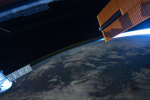
Denizens of planet Earth typically watch meteor showers by looking up. But this remarkable view, captured on August 13, 2011 by astronaut Ron Garan, caught a Perseid meteor by looking down. From Garan...
 NGC 2736: The Pencil Nebula
15.07.2016
Moving from top to bottom in the frame near the center of this sharply detailed color composite, thin, bright, braided filaments are actually long ripples in a cosmic sheet of glowing gas seen almost edge-on. The shock wave plows through interstellar space at over 500,000 kilometers per hour.
 Stephan's Quintet from Hubble
3.06.2019
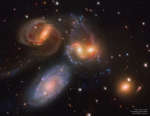
When did these big galaxies first begin to dance? Really only four of the five of Stephan's Quintet are locked in a cosmic tango of repeated close encounters taking place some 300 million light-years away.
|
January February March April May |
|||||||||||||||||||||||||||||||||||||||||||||||||