
|
You entered: white dwarf
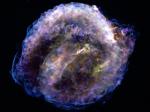 Keplers Supernova Remnant in X Rays
16.01.2007
What caused this mess? Some type of star exploded to create the unusually shaped nebula known as Kepler's supernova remnant, but which type? Light from the stellar explosion that created this energized cosmic cloud was first seen on planet Earth in October 1604, a mere four hundred years ago.
 SNR 0104: An Unusual Suspect
12.06.2009
SNR 0104 is a supernova remnant with an unusual shape. Found 190,000 light-years away in our neighboring galaxy the Small Magellanic Cloud, SNR 0104 is suspected of being the expanding debris cloud from a Type 1a supernova - the catastrophic thermonuclear explosion of a white dwarf star.
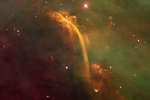 HH 222: The Waterfall Nebula
24.10.2011
What created the Waterfall Nebula? No one knows. The structure seen in the region of NGC 1999 in the Great Orion Molecular Cloud complex is one of the more mysterious structures yet found on the sky. Designated HH-222, the elongated gaseous stream stretches about ten light years and emits an unusual array of colors.
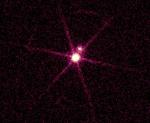 X-Rays From Sirius B
6.10.2000
In visible light Sirius A (Alpha Canis Majoris) is the brightest star in the night sky, a closely watched celestial beacon throughout recorded history. Part of a binary star system only 8 light-years away, it was known in modern times to have a small companion star, Sirius B.
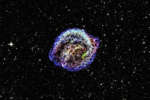 Kepler's Supernova Remnant in X Rays
15.05.2013
What caused this mess? Some type of star exploded to create the unusually shaped nebula known as Kepler's supernova remnant, but which type? Light from the stellar explosion that created this energized cosmic cloud was first seen on planet Earth in October 1604, a mere four hundred years ago.
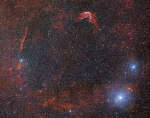 RCW 86: Historical Supernova Remnant
3.03.2023
In 185 AD, Chinese astronomers recorded the appearance of a new star in the Nanmen asterism. That part of the sky is identified with Alpha and Beta Centauri on modern star charts. The new star was visible to the naked-eye for months, and is now thought to be the earliest recorded supernova.
 GL 105C: The Coolest Star?
20.09.1995
Is the dim star to the upper right of this false-color picture the coolest possible normal star? From this recent picture by the Hubble Space Telescope, astronomers have estimated its mass is just high enough for it to fuse hydrogen into helium in its core.
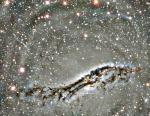 Centaurus A: Young Blue Star Stream
17.10.2002
Almost lost in this cosmic jumble of stars, gas and dust is a faint but definite blue arc -- a stream of young stars whose formation was probably triggered as a small dwarf galaxy was torn apart approaching the giant elliptical galaxy Centaurus A.
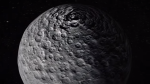 Fly Over Dwarf Planet Ceres
10.06.2015
What would it look like to fly over dwarf planet Ceres? Animators from the German Aerospace Center recently took actual images and height data from NASA's robotic Dawn mission -- currently visiting Ceres -- to generate several fascinating virtual sequences.
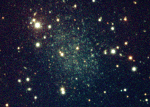 Antlia: A New Galactic Neighbor
23.04.1997
Meet Antlia, a newly discovered neighbor of our Milky Way Galaxy. Announced just last week, this faint member of our Local Group of Galaxies has only about one million stars. It is late in being noticed because it is so hard to see against a bright sky.
|
January February March April May June July August September |
|||||||||||||||||||||||||||||||||||||||||||||||||