
|
You entered: telescope
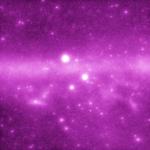 GLAST Gamma Ray Sky Simulation
22.07.2000
What shines in the gamma-ray sky? This simulated image models the intensities of gamma rays with over 40 million times the energy of visible light, and represents how the sky might appear to the Gamma-ray Large Area Space Telescope (GLAST) after its first year in orbit.
 The Tarantula Nebula from SuperBIT
27.04.2023
The Tarantula Nebula, also known as 30 Doradus, is more than a thousand light-years in diameter, a giant star forming region within nearby satellite galaxy the Large Magellanic Cloud. About 160 thousand light-years away, it's the largest, most violent star forming region known in the whole Local Group of galaxies.
 Edwin Hubble Discovers the Universe
17.02.1996
No person in history has had greater impact in determining the extent of our universe than Edwin Hubble. From proving that other galaxies existed to proving that galaxies move apart from one another, Hubble's work defined our place in the cosmos.
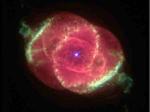 The Cats Eye Nebula
24.03.2002
Three thousand light-years away, a dying star throws off shells of glowing gas. This image from the Hubble Space Telescope reveals the Cat's Eye Nebula to be one of the most complex planetary nebulae known.
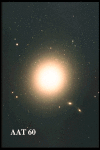 Elliptical Galaxy M87
13.09.1995
Elliptical galaxy M87 is a type of galaxy that looks much different than our own Milky Way Galaxy. But even for an elliptical galaxy M87 is peculiar. M87 is much bigger than an average...
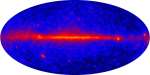 Fermi's First Light
28.08.2008
Launched on June 11 to explore the universe at extreme energies, the Gamma-ray Large Area Space Telescope has been officially renamed the Fermi Gamma-ray Space Telescope, in honor of Nobel Laureate Enrico Fermi (1901-1954), pioneer in high-energy physics.
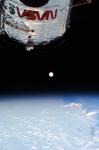 Earth, Moon, Hubble
5.01.2000
The Space Shuttle Discovery Crew was fortunate enough to witness one of the brighter full moon's from orbit two weeks ago during their mission to fix the Hubble Space Telescope. Pictured...
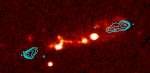 An Energetic Radio Galaxy
30.09.1995
The radio and optical emission seen in the above superposed images of the radio galaxy 3C368 indicate that energetic processes are at work. A radio galaxy is a galaxy that is visible to radio telescopes. A large radio signal usually indicates very powerful phenomena.
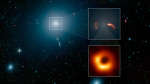 The Galaxy, the Jet and the Black Hole
27.04.2019
Bright elliptical galaxy Messier 87 (M87) is home to the supermassive black hole captured by planet Earth's Event Horizon Telescope in the first ever image of a black hole. Giant of the Virgo...
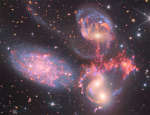 Stephans Quintet from Webb, Hubble, and Subaru
18.07.2022
OK, but why can't you combine images from Webb and Hubble? You can, and today's featured image shows one impressive result. Although the recently launched James Webb Space Telescope (Webb) has a larger mirror than Hubble, it specializes in infrared light and can't see blue -- only up to about orange.
|
January February March April May June July August |
||||||||||||||||||||||||||||||||||||||||||||||||||||||||