
|
You entered: planets
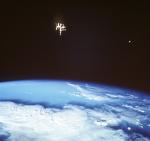 The Moons of Earth
30.04.2005
While orbiting the planet during their June 1998 mission, the crew of the Space Shuttle Discovery photographed this view of two moons of Earth. Thick storm clouds are visible in the lovely blue planet...
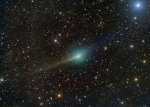 3I/ATLAS Flyby
26.12.2025
Attention grabbing interstellar visitor 3I/ATLAS made its not-so-close flyby of our fair planet on December 19 at a distance of 1.8 astronomical units. That's about 900 light-seconds. This deep exposure captures the comet...
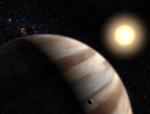 Extra Solar Planetary Atmosphere Detected
28.11.2001
By directly detecting the atmosphere of a planet outside our Solar System, humanity has taken another small step toward finding extraterrestrial life. The unexpected detection by David Charbonneau (Caltech) and associates came from Hubble Space Telescope observations of Sun-like star HD 209458.
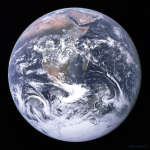 Blue Marble Earth
6.02.2022
Welcome to planet Earth, the third planet from a star named the Sun. The Earth is shaped like a sphere and composed mostly of rock. Over 70 percent of the Earth's surface is water. The planet has a relatively thin atmosphere composed mostly of nitrogen and oxygen.
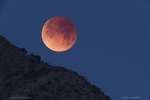 Moonset Eclipse
1.02.2018
Near the closest point in its orbit, the second Full Moon of the month occurred on January 31. So did the first Total Lunar Eclipse of 2018, as the Moon slid through planet Earth's shadow.
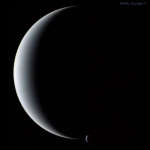 Crescent Neptune and Triton
27.05.2023
Gliding through the outer Solar System, in 1989 the Voyager 2 spacecraft looked toward the Sun to find this view of most distant planet Neptune and its moon Triton together in a crescent phase. The elegant image of ice-giant planet and largest moon was taken from behind just after Voyager's closest approach.
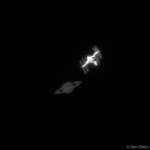 Saturn and ISS
9.07.2022
Soaring high in skies around planet Earth, bright planet Saturn was a star of June's morning planet parade. But very briefly on June 24 it posed with a bright object in low Earth orbit, the International Space Station.
 Mars Passing By
2.08.2024
As Mars wanders through Earth's night, it passes about 5 degrees south of the Pleiades star cluster in this composite astrophoto. The skyview was constructed from a series of images captured over a run of 16 consecutive clear nights beginning on July 12.
 Mars Saturn Conjunction
9.04.2022
Fainter stars in the zodiacal constellation Capricornus are scattered near the plane of the ecliptic in this field of view. The two brightest ones at center aren't stars at all though, but the planets Mars and Saturn.
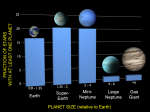 Ten Billion Earths
12.01.2013
How common are Earth-sized planets? Quite common, according to extrapolations from new data taken by NASA's orbiting Kepler spacecraft. Current computer models are indicating that at least one in ten stars are orbited by an Earth-sized planet, making our Milky Way Galaxy the home to over ten billion Earths.
|
January February March April May June July August September |
|||||||||||||||||||||||||||||||||||||||||||||||||