
|
You entered: ocean
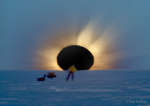 A Total Eclipse at the End of the World
14.03.2015
Would you go to the end of the world to see a total eclipse of the Sun? If you did, would you be surprised to find someone else there already? In 2003, the Sun, the Moon, Antarctica, and two photographers all lined up in Antarctica during an unusual total solar eclipse.
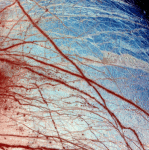 The Cracked Ice Plains of Europa
22.10.1996
What caused the cracks in this giant ice-ball? Jupiter's moon Europa has smoothest surface in the solar system and is composed mostly of cracked water-ice. In the above false-colored picture released last week...
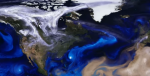 Hurricane Season Animated
26.11.2017
Where do hurricanes go? To better understand dangerous storms, NASA compiled data from several satellites into a supercomputer simulation of this past year's hurricane season. Specifically, the featured video shows how smoke (white), sea salt (blue), and dust (brown) tracked from 2017 August through October across the northern half of Earth's Western Hemisphere.
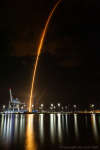 Crew 1 Mission Launch Streak
18.11.2020
Leaving planet Earth for a moment, a SpaceX Falcon 9 rocket arced into the early evening sky last Sunday at 7:27 pm EST. This 3 minute 20 second exposure traces the launch streak over Kennedy Space Center's Launch Complex 39A.
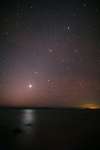 Ecliptic New Zealand
10.07.2010
Four bright celestial beacons and a faint triangle of light follow the plane of the ecliptic as it arcs high through this southern hemisphere night skyscape. Seen on a July winter night from Lake...
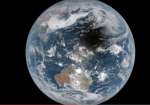 Moon Shadow versus Sun Reflection
16.07.2017
What are those lights and shadows crossing the Earth? As the featured five-second time-lapse video progresses, a full day on planet Earth is depicted as seen from Japan's Himawari-8 satellite in geostationary orbit high above the Pacific Ocean.
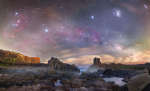 From Orion to the Southern Cross
17.01.2022
This is a sky filled with glowing icons. On the far left is the familiar constellation of Orion, divided by its iconic three-aligned belt stars and featuring the famous Orion Nebula, both partly encircled by Barnard's Loop. Just left of center in the featured image is the brightest star in the night: Sirius.
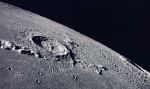 The Barren Moon
30.10.1996
The above photo, taken as the Apollo 17 astronauts orbited the Moon in 1972, depicts the stark lunar surface around the Eratosthenes and Copernicus craters. Many similar images of a Moon devoid of life are familiar to denizens of the space age.
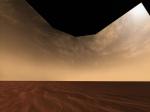 Clouds and Sand on the Horizon of Mars
17.10.2006
If you could stand on Mars -- what might you see? Like the robotic Opportunity rover rolling across the red planet, you might well see vast plains of red sand, an orange tinted sky, and wispy light clouds.
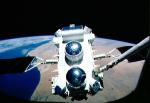 The Compton Gamma Ray Observatory
15.01.2000
The Compton Gamma Ray Observatory (CGRO) was the most massive instrument ever launched by a NASA Space Shuttle in 1991 and continues to revolutionize gamma-ray astronomy. Before Compton loses more stabilizing gyroscopes, NASA is considering firing onboard rockets to bring it on a controlled reentry into the ocean.
|
January February March April May June July August September |
|||||||||||||||||||||||||||||||||||||||||||||||||