
|
You entered: magnetic field
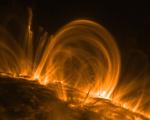 Heating Coronal Loops
28.09.2000
Extending above the photosphere or visible surface of the Sun, the faint, tenuous solar corona can't be easily seen from Earth, but it is measured to be hundreds of times hotter than the photosphere itself. What makes the solar corona so hot?
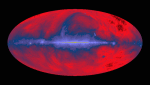 The Radio Sky: Tuned to 408MHz
3.04.1999
Tune your radio telescope to 408MHz (408 million cycles per second) and check out the Radio Sky! You should find that frequency on your dial somewhere between US broadcast television channels 13 and 14.
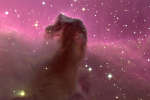 The Horsehead Nebula
21.07.2009
One of the most identifiable nebulae in the sky, the Horsehead Nebula in Orion, is part of a large, dark, molecular cloud. Also known as Barnard 33, the unusual shape was first discovered on a photographic plate in the late 1800s.
 The Horsehead Nebula
21.10.2012
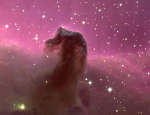
One of the most identifiable nebulae in the sky, the Horsehead Nebula in Orion, is part of a large, dark, molecular cloud. Also known as Barnard 33, the unusual shape was first discovered on a photographic plate in the late 1800s.
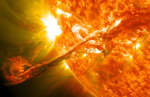 A Solar Filament Erupts
20.07.2014
What's happened to our Sun? Nothing very unusual -- it just threw a filament. Toward the middle of 2012, a long standing solar filament suddenly erupted into space producing an energetic Coronal Mass Ejection (CME).
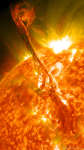 A Solar Filament Erupts
15.09.2018
What's happened to our Sun? Nothing very unusual -- it just threw a filament. Toward the middle of 2012, a long standing solar filament suddenly erupted into space producing an energetic Coronal Mass Ejection (CME).
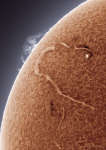 A Long Snaking Filament on the Sun
12.09.2022
Earlier this month, the Sun exhibited one of the longer filaments on record. Visible as the bright curving streak around the image center, the snaking filament's full extent was estimated to be over half of the Sun's radius -- more than 350,000 kilometers long.
 50000 Kilometers over the Sun
18.09.2016
What's happening at the edge of the Sun? Although it may look like a monster is rampaging, what is pictured is actually only a monster prominence -- a sheath of thin gas held above the surface by the Sun's magnetic field.
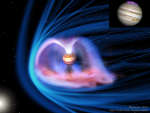 Auroras and the Magnetosphere of Jupiter
5.04.2016
Jupiter has auroras. Like near the Earth, the magnetic field of our Solar System's largest planet compresses when impacted by a gust of charged particles from the Sun. This magnetic compression funnels charged particles towards Jupiter's poles and down into the atmosphere.
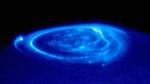 A Close Up of Aurora on Jupiter
18.12.2000
Jupiter has aurorae. Like Earth, the magnetic field of the gas giant funnels charged particles released from the Sun onto the poles. As these particles strike the atmosphere, electrons are temporarily knocked away from existing gas molecules. Electric force attracts these electrons back. As the electrons recombine to remake neutral molecules, auroral light is emitted.
|
January February March April May June July August September October |
|||||||||||||||||||||||||||||||||||||||||||||||||