
|
You entered: launch
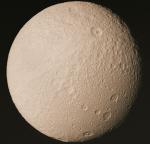 Saturns Moon Tethys
19.05.2002
Tethys is one of the larger and closer moons of Saturn. It was visited by both Voyager spacecraft - Voyager 1 in November 1980 and by Voyager 2 in August 1981. Tethys is now known to be composed almost completely of water ice. Tethys shows a large impact crater that nearly circles the planet.
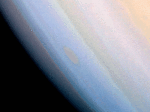 Saturn's Cloud Tops
17.03.1996
This close-up of the tops of Saturn's clouds was taken by the Voyager 1 robot spacecraft as it passed the giant planet in November 1980. Saturn's clouds are mostly composed of hydrogen and helium gas, but the small addition of other elements gives the clouds their colors.
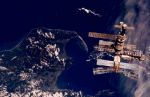 Mir Dreams
3.06.1996
This dream-like image of Mir was recorded by astronauts as the Space Shuttle Atlantis approached the Russian Space Station prior to docking during the STS-76 mission. Sporting spindly appendages and solar pannels, Mir resembles a whimsical flying insect as it orbits above New Zealand's South Island near the Cook Straight.
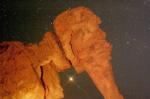 Mars Rising Behind Elephant Rock
28.08.2003
Yesterday, at about 10 am Universal Time, Mars and Earth passed closer than in nearly 60,000 years. Mars, noticeably red, remains the brightest object in the eastern sky just after sunset. The best...
 The Fogs of Mars
2.06.2003
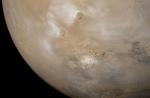
Fogs of clouds and dust covered parts of southern Mars during last Martian winter. Giant volcanoes, such as Ascraeus Mons, the central circular feature near the top of the image, were surrounded by large water clouds. Slightly southwest, Pavonis Mons and Arisa Mons also peeked above their water clouds.
 Columbia Dawn
8.03.2002
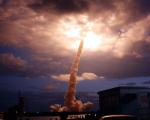
Trailing a thick column of exhaust, the Space Shuttle Columbia blasted into the twilight morning sky on March 1, its thundering rockets briefly flooding a cloud bank with the light of a false dawn. The event marked the start of the ongoing eleven day mission to upgrade the Hubble Space Telescope.
 The Compton Gamma Ray Observatory
11.08.1995
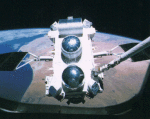
The Compton Gamma Ray Observatory (CGRO) was the most massive instrument ever launched by a NASA Space Shuttle and continues to revolutionize gamma-ray astronomy. This orbiting observatory sees the sky in gamma-ray photons - light so blue humans can't see it.
 Saturn Rotates
3.10.2000
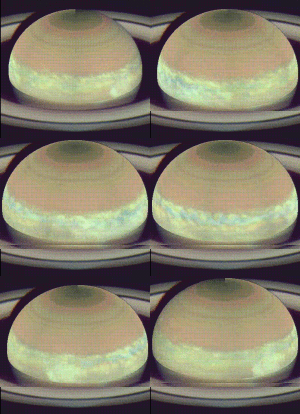
The dramatic rotation of the cloud-tops of Saturn every ten-hours is particularly evident from orbit around the gas giant planet. With a good enough telescope, however, such rotation is visible even from Earth, as shown by this time-lapse image sequence from the Hubble Space Telescope taken in November 1990.
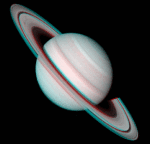 Stereo Saturn
29.10.1997
Get out your red/blue glasses and launch yourself into this stereo picture of Saturn! The picture is actually composed from two images recorded weeks apart by the Voyager 2 spacecraft during its visit to the Saturnian System in August of 1981.
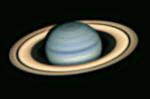 Saturn from Earth
2.09.1998
Saturn is the second largest planet in our Solar System. Saturn has been easily visible in the sky since history has been recorded. Galileo used one of the first telescopes in 1610 to discover Saturn's rings, which he first thought were moons.
|
January February March April May |
|||||||||||||||||||||||||||||||||||||||||||||||||