
|
You entered: hot star
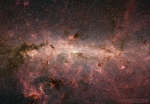 The Galactic Center in Infrared
18.04.2021
What does the center of our galaxy look like? In visible light, the Milky Way's center is hidden by clouds of obscuring dust and gas. But in this stunning vista, the Spitzer Space Telescope's infrared cameras, penetrate much of the dust revealing the stars of the crowded galactic center region.
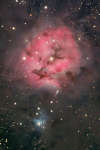 IC 5146: The Cocoon Nebula
26.08.2022
Inside the Cocoon Nebula is a newly developing cluster of stars. Cataloged as IC 5146, the beautiful nebula is nearly 15 light-years wide. Climbing high in northern summer night skies, it's located some 4,000 light years away toward the constellation Cygnus the Swan.
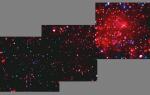 X Ray Stars and Winds in the Rosette Nebula
19.10.2001
This mosaic of x-ray images cuts a swath across the photogenic Rosette Nebula, a stellar nursery 5,000 light-years from Earth in the constellation Monoceros, the Unicorn. Constructed from data recorded by the orbiting...
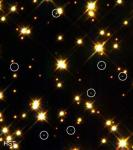 White Dwarf Stars Cool
1.11.1997
Diminutive by stellar standards, white dwarf stars are also intensely hot ... but they are cooling. No longer do their interior nuclear fires burn, so they will continue to cool until they fade away. This Hubble Space Telescope image covers a small region near the center of a globular cluster known as M4.
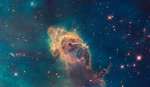 Carina Pillar and Jets
1.10.2009
This cosmic pillar of gas and dust is nearly 2 light-years wide. The structure lies within one of our galaxy's largest star forming regions, the Carina Nebula, shining in southern skies at a distance of about 7,500 light-years.
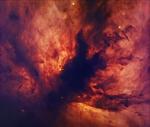 Flame Nebula Close Up
1.02.2007
Of course, the Flame Nebula is not on fire. Also known as NGC 2024, the nebula's suggestive reddish color is due to the glow of hydrogen atoms at the edge of the giant Orion molecular cloud complex some 1,500 light-years away.
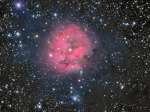 IC 5146: The Cocoon Nebula
27.08.2008
Inside the Cocoon Nebula is a newly developing cluster of stars. Cataloged as IC 5146, the beautiful nebula is nearly 15 light-years wide, located some 4,000 light years away toward the northern constellation Cygnus.
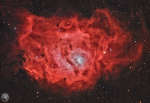 The Lagoon Nebula is Stars, Gas, and Dust
11.11.2018
The majestic Lagoon Nebula is filled with hot gas and the home for many young stars. Spanning 100 light years across while lying only about 5000 light years distant, the Lagoon Nebula is so big and bright that it can be seen without a telescope toward the constellation of the Archer (Sagittarius).
 Naked Eye Nova Centauri 2013
7.12.2013
Brightest stellar beacons of the constellation Centaurus, Alpha and Beta Centauri are easy to spot from the southern hemisphere. For now, so is new naked eye Nova Centauri 2013. In this night skyscape recorded...
 Flame Nebula Close Up
25.11.2010
Of course, the Flame Nebula is not on fire. Also known as NGC 2024, the nebula's suggestive reddish color is due to the glow of hydrogen atoms at the edge of the giant Orion molecular cloud complex some 1,500 light-years away.
|
January February |
|||||||||||||||||||||||||||||||||||||||||||||||||