
|
You entered: full moon
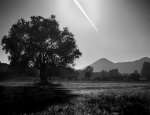 The Moon Entering Earth s Shadow
9.10.2015
On September 27/28, from all over the planet's nightside moon watchers enjoyed a total lunar eclipse. The dramatic celestial spectacle was widely imaged, but this lunar eclipse picture may look a little strange and unfamiliar, made with a point and shoot camera of a bygone era.
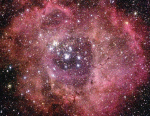 Star Cluster in the Rosette Nebula
22.05.1996
Embedded in the center of the colorful and photogenic Rosette Nebula is a bright, young open cluster. The bright blue stars in this cluster, labelled NGC 2244, emit ultraviolet light that knocks electrons away from hydrogen atoms.
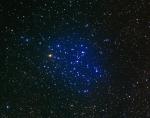 M6: The Butterfly Cluster
6.01.1999
To some, the outline of the open cluster of stars M6 resembles a butterfly. M6, also known as NGC 6405, spans about 20 light-years and lies about 2,000 light years distant.
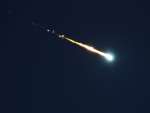 Fireball Meteor Over Groningen
15.10.2009
The brilliant fireball meteor captured in this snapshot was a startling visitor to Tuesday evening's twilight skies over the city of Groningen. In fact, sightings of the meteor, as bright as the Full Moon, were widely reported throughout the Netherlands and Germany at approximately 17:00 UT.
 APOD: 2023 October 29 Б A Partial Lunar Eclipse
29.10.2023
What's happened to the Moon? Within the last day, part of the Moon moved through the Earth's shadow. This happens about once or twice a year, but not every month since the Moon's orbit around the Earth is slightly tilted.
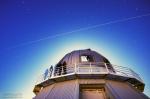 ISS Over Mont Megantic Observatory
18.08.2007
On August 1st, a time exposure created this surreal view that looks up into the early morning sky over southern Quebec. Only the light from a nearly Full Moon brightens the sky and highlights the dome of the 1.6 meter telescope at Mont-Megantic Observatory.
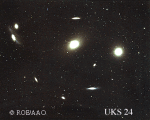 Virgo Cluster Galaxies
13.11.1995
Pictured are several galaxies of the Virgo Cluster, the closest cluster of galaxies to the Milky Way. The Virgo Cluster spans more than 5 degrees on the sky - about 10 times the angle made by a full Moon. It contains over 100 galaxies of many types - including spirals, ellipticals, and irregular galaxies.
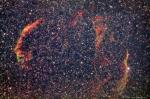 Wisps of the Veil Nebula
4.02.2003
These wisps of gas are all that remain visible of a Milky Way star. Many thousands of years ago that star exploded in a supernova leaving the Veil Nebula, pictured above. At the time...
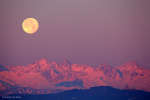 Alpine Superga Moonset
8.12.2017
December's Full Moon phase occurred near perigee, the closest point in its orbit around our fair planet. Big and bright, the fully illuminated lunar disk sets over rugged mountains in this early morningscape from Turin, Italy.
 Planets on the Wing
6.01.2018
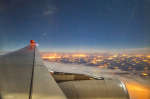
Lately, bright Jupiter and fainter Mars have been easy to spot for early morning skygazers. Before dawn on January 7 the two naked-eye planets will reach a close conjunction near the horizon, only 1/4 degree apart in predawn eastern skies. That apparent separation corresponds to about half the angular diameter of a Full Moon.
|
January February March April May June July August |
||||||||||||||||||||||||||||||||||||||||||||||||||||||||