
|
You entered: all sky
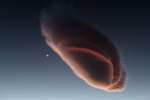 Lenticular Cloud, Moon, Mars, Venus
1.03.2015
It is not every day that such an interesting cloud photobombs your image. The original plan was to photograph a rare angular conjunction of Mars and Venus that occurred a week and a half ago, with the added bonus of a crescent Moon and the International Space Station (ISS) both passing nearby.
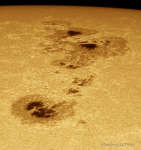 APOD: 2026 June 28 Б AR 4478: Giant Sunspot Group
28.06.2026
Right now, one of the largest sunspot groups in recent history is crossing the Sun. Active Region 4478 is not only big -- it's violent, showing tangled magnetic fields capable of throwing off huge clouds of particles into the Solar System. Some of these CMEs might impact the Earth.
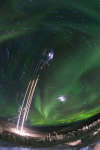 A Night at Poker Flat
29.01.2015
Four NASA suborbital sounding rockets leapt into the night on January 26, from the University of Alaska's Poker Flat Research Range. This time lapse composite image follows all four launches of the small, multi-stage rockets to explore winter's mesmerizing, aurora-filled skies.
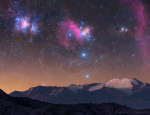 Orion over Argentine Mountains
9.06.2020
Do you recognize the constellation of Orion? It may be harder than usual in today's featured image because the camera has zoomed in on the center, and the exposure is long enough to enhance nebulas beyond what the unaided human eye can see.
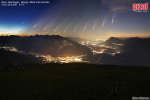 Comet NEOWISE over the Swiss Alps
15.07.2020
Comet NEOWISE has been wowing photographers around much of the world during dawn and dusk, at the margins of day and night. For the most northern residents of planet Earth, however, the comet circles the North Star and never sets.
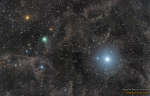 Polaris and Comet Lovejoy
2.06.2015
One of these two bright sky objects is moving. On the right is the famous star Polaris. Although only the 45th brightest star in the sky, Polaris is famous for appearing stationary. Once you find it, it will always appear in the same direction -- all night and all day -- for the rest of your life.
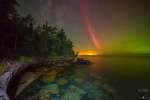 A Proton Arc Over Lake Superior
3.08.2015
The setting had been picked out -- all that was needed was an aurora. And late last August, forecasts predicted that an otherwise beautiful night sky would be lit up with auroral green. Jumping into...
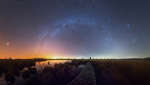 Summer to Winter Milky Way
19.10.2018
Taken near local midnight, this autumn night's panorama follows the arch of the Milky Way across the northern horizon from the High Fens, Eifel Nature Park at the border of Belgium and Germany.
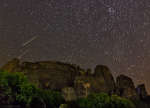 Perseids over Meteora
10.08.2013
The two bright meteors flashing through this night skyscape from August 7 are part of the ongoing Perseid meteor shower. In the direction indicated by both colorful streaks, the shower's radiant in the eponymous constellation Perseus is at the upper right.
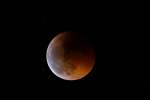 Eclipsed Moonlight
21.06.2011
A celestial prelude to today's solstice, the June 15 total lunar eclipse was one of the longest in recent years. It was also one of the darkest, but not completely dark. Even during...
|
January February March April May June July August September |
|||||||||||||||||||||||||||||||||||||||||||||||||