
|
You entered: TRACE
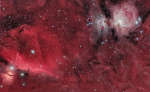 Horsehead and Orion Nebulas
5.10.2010
The dark Horsehead Nebula and the glowing Orion Nebula are contrasting cosmic vistas. Adrift 1,500 light-years away in one of the night sky's most recognizable constellations, they appear in opposite corners of the above stunning mosaic.
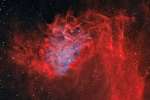 AE Aurigae and the Flaming Star Nebula
10.03.2011
AE Aurigae is the bright star below and left of center in this evocative portrait of IC 405, also known as the Flaming Star Nebula. Embedded in the cosmic cloud, the hot, variable O-type star energizes the glow of hydrogen along convoluted filaments of atomic gas, its blue starlight scattered by interstellar dust.
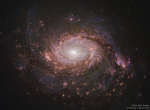 M77: Spiral Galaxy with an Active Center
16.03.2020
What's happening in the center of nearby spiral galaxy M77? The face-on galaxy lies a mere 47 million light-years away toward the constellation of the Sea Monster (Cetus). At that estimated distance, this gorgeous island universe is about 100 thousand light-years across.
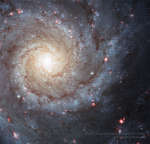 APOD: 2026 August 30 Б M74: A Grand Design Spiral
29.08.2026
If not the most grand, then this spiral galaxy is at least one of the most photogenic. An island universe of about 100 billion stars, 32 million light-years away toward the constellation Pisces, M74 presents a gorgeous face-on view.
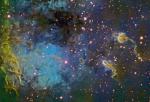 The Tadpoles of IC 410
10.01.2006
This close-up view shows a portion of otherwise faint emission nebula IC 410 in striking false-colors. It also shows two remarkable denizens of the glowing gas cloud at the right - the "tadpoles" of IC 410. The picture is a composite of images taken through narrow band filters intended to trace atoms in the nebula.
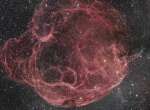 Simeis 147: Supernova Remnant
11.02.2011
It's easy to get lost following the intricate filaments in this detailed mosaic image of faint supernova remnant Simeis 147. Also cataloged as Sh2-240 and seen towards the constellation Taurus, it covers nearly 3 degrees (6 full moons) on the sky.
 APOD: 2025 January 8 Б Supernova Remnants Big and Small
7.01.2025
What happens after a star explodes? A huge fireball of hot gas shoots out in all directions. When this gas slams into the existing interstellar medium, it heats up so much it glows. Two different supernova remnants (SNRs) are visible in the featured image, taken at the Oukaцmeden Observatory in Morocco.
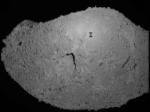 A Robots Shadow on Asteroid Itokawa
15.11.2005
What's that unusual looking spot on asteroid Itokawa? It's the shadow of the robot spacecraft Hayabusa that took the image. Japan's Hayabusa mission arrived at the asteroid in early September and has been imaging and maneuvering around the floating space mountain ever since. The above picture was taken earlier this month.
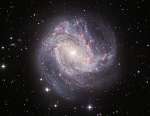 M83: The Thousand Ruby Galaxy
27.09.2008
Big, bright, and beautiful, spiral galaxy M83 lies a mere twelve million light-years away, near the southeastern tip of the very long constellation Hydra. Prominent spiral arms traced by dark dust lanes and blue star clusters lend this galaxy its popular name of the Southern Pinwheel.
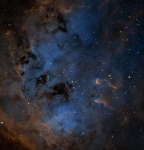 The Tadpoles of IC 410
9.01.2014
This telescopic close-up shows off the otherwise faint emission nebula IC 410 in striking false-colors. It also features two remarkable inhabitants of the cosmic pond of gas and dust below and right of center, the tadpoles of IC 410. The picture is a composite of images taken through narrow band filters.
|
January February March April May June July August September |
|||||||||||||||||||||||||||||||||||||||||||||||||