
|
You entered: NGC catalog
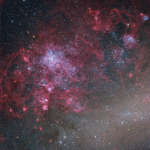 The Tarantula Zone
12.06.2014
The Tarantula Nebula is more than 1,000 light-years in diameter, a giant star forming region within our neighboring galaxy the Large Magellanic Cloud (LMC). That cosmic arachnid lies toward the upper left in this deep and colorful telescopic view made through broad-band and narrow-band filters.
 The Tarantula Nebula from SuperBIT
26.04.2023
The Tarantula Nebula, also known as 30 Doradus, is more than a thousand light-years in diameter, a giant star forming region within nearby satellite galaxy the Large Magellanic Cloud. About 160 thousand light-years away, it's the largest, most violent star forming region known in the whole Local Group of galaxies.
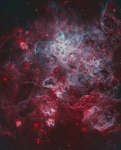 The Tarantula Zone
12.11.2020
The Tarantula Nebula, also known as 30 Doradus, is more than a thousand light-years in diameter, a giant star forming region within nearby satellite galaxy the Large Magellanic Cloud. About 180 thousand light-years away, it's the largest, most violent star forming region known in the whole Local Group of galaxies.
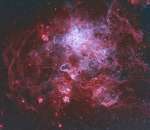 The Tarantula Nebula
15.11.2017
The Tarantula Nebula is more than a thousand light-years in diameter, a giant star forming region within nearby satellite galaxy the Large Magellanic Cloud, about 180 thousand light-years away. The largest, most violent star...
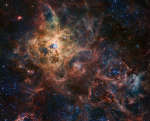 The Tarantula Nebula
25.02.2016
The Tarantula Nebula is more than a thousand light-years in diameter, a giant star forming region within nearby satellite galaxy the Large Magellanic Cloud, about 180 thousand light-years away. The largest, most violent star...
 The Tarantula Nebula
16.11.2018
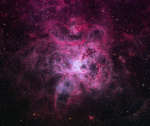
The Tarantula Nebula, also known as 30 Doradus, is more than a thousand light-years in diameter, a giant star forming region within nearby satellite galaxy the Large Magellanic Cloud. About 180 thousand light-years away, it's the largest, most violent star forming region known in the whole Local Group of galaxies.
 The Tarantula Zone
7.03.2024
The Tarantula Nebula, also known as 30 Doradus, is more than a thousand light-years in diameter, a giant star forming region within nearby satellite galaxy the Large Magellanic Cloud. About 180 thousand light-years away, it's the largest, most violent star forming region known in the whole Local Group of galaxies.
 SN 2006GY: Brightest Supernova
10.05.2007
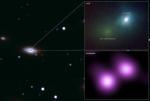
The stellar explosion cataloged as supernova SN 2006gy shines in this wide-field image (left) of its host galaxy, NGC 1260, and expanded view (upper right panel) of the region surrounding the galaxy's core.
 The Tarantula Zone
15.09.2022
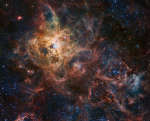
The Tarantula Nebula, also known as 30 Doradus, is more than a thousand light-years in diameter, a giant star forming region within nearby satellite galaxy the Large Magellanic Cloud. About 180 thousand light-years away, it's the largest, most violent star forming region known in the whole Local Group of galaxies.
 NGC 7814: Little Sombrero with Supernova
21.07.2021
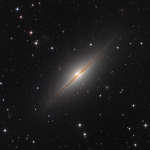
Point your telescope toward the high flying constellation Pegasus and you can find this expanse of Milky Way stars and distant galaxies. NGC 7814 is centered in the pretty field of view that would almost be covered by a full moon.
|
January February March April May June July August September |
|||||||||||||||||||||||||||||||||||||||||||||||||