
|
You entered: Earth's rotation
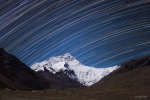 Mount Everest Star Trails
1.12.2018
The highest peak on planet Earth is framed in this mountain and night skyscape. On September 30, the digital stack of 240 sequential exposures made with a camera fixed to a tripod at an Everest Base Camp captured the sheer north face of the Himalayan mountain and foreground illuminated by bright moonlight.
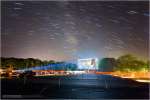 Night at the Drive In
20.09.2013
Colorful stars trail through this late summer, night skyscape from Cape Cod, Massachusetts. The picture was composed by stacking 12 consecutive 1 minute long digital camera exposures to follow the trails, a reflection of our fair planet's daily rotation.
 A Gemini Sky
9.09.2003
Where will Gemini take us tonight? It is dusk and Gemini North, one of the largest telescopes on planet Earth, prepares to peer into the distant universe. Gemini's flexible 8.1-mirror has taken...
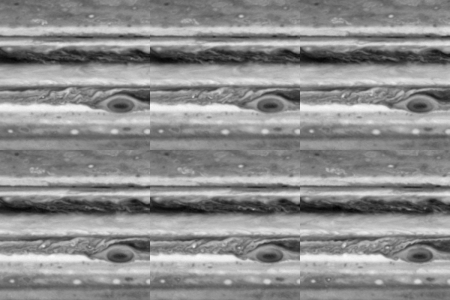 Cassini At Jupiter: Red Spot Movie
23.11.2000
Everything is big on Jupiter, the solar system's reigning gas giant. For example, Jupiter's Great Red Spot is a hurricane-like storm system at least twice the diameter of planet Earth. Approaching Jupiter...
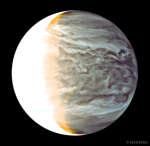 Night on Venus in Infrared from Orbiting Akatsuki
7.06.2016
Why is Venus so different from Earth? To help find out, Japan launched the robotic Akatsuki spacecraft which entered orbit around Venus late last year after an unplanned five-year adventure around the inner Solar System.
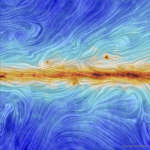 Our Galaxys Magnetic Field from Planck
26.01.2015
What does the magnetic field of our Galaxy look like? It has long been known that a modest magnetic field pervades our Milky Way Galaxy because it is seen to align small dust grains that scatter background light. Only recently, however, has the Earth-orbiting Planck satellite made a high-resolution map of this field.
 Phobos: Moon over Mars
22.03.2024
A tiny moon with a scary name, Phobos emerges from behind the Red Planet in this timelapse sequence from the Earth-orbiting Hubble Space Telescope. Over 22 minutes the 13 separate exposures were captured near the 2016 closest approach of Mars to planet Earth. Martians have to look to the west to watch Phobos rise, though.
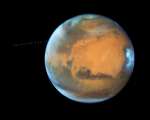 Phobos: Moon over Mars
21.07.2017
A tiny moon with a scary name, Phobos emerges from behind the Red Planet in this timelapse sequence from the Earth-orbiting Hubble Space Telescope. Over 22 minutes the 13 separate exposures were captured near the 2016 closest approach of Mars to planet Earth. Martians have to look to the west to watch Phobos rise, though.
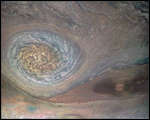 North North Temperate Zone Little Red Spot
4.08.2017
On July 11, the Juno spacecraft once again swung near the turbulent Jovian cloud tops. On its seventh orbital closest approach this perijove passage brought Juno within 3,500 kilometers of the Solar System's largest planetary atmosphere.
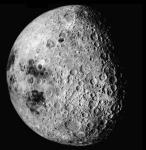 Far Side of the Moon
8.10.1998
Locked in synchronous rotation, the Moon always presents its well-known near side to Earth. But from lunar orbit, Apollo astronauts also grew to know the Moon's far side. This sharp picture from Apollo...
|
January February March April May June July August September October |
|||||||||||||||||||||||||||||||||||||||||||||||||