
|
You entered: Moon
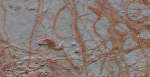 The Surface of Europa
19.05.2016
An enhanced-color view, this image covers a 350 by 750 kilometer swath across the surface of Jupiter's tantalizing moon Europa. The close-up combines high-resolution image data with lower resolution color data from observations made in 1998 by the Galileo spacecraft.
 A Beautiful Trifid
4.07.2024
The beautiful Trifid Nebula is a cosmic study in contrasts. Also known as M20, it lies about 5,000 light-years away toward the nebula rich constellation Sagittarius. A star forming region in the plane...
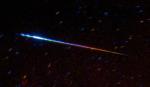 A Perseid Meteor
12.08.2000
This weekend, the annual Perseid Meteor Shower reaches its maximum. Grains of cosmic sand and gravel shed from Comet Swift-Tuttle will streak across the sky as they vaporize during entry into Earth's atmosphere. The Perseids result from the yearly
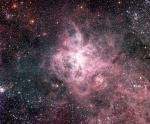 The Tarantula Zone
23.08.2003
The Tarantula Nebula is more than 1,000 light-years across - a giant emission nebula within our neighboring galaxy the Large Magellanic Cloud. Inside this cosmic arachnid lies a central young cluster of massive stars, cataloged as R136, whose intense radiation and strong winds have helped energize the nebular glow and shape the spidery filaments.
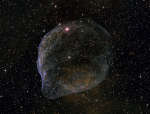 Sharpless 308: Star Bubble
24.12.2013
Blown by fast winds from a hot, massive star, this cosmic bubble is huge. Cataloged as Sharpless 2-308 it lies some 5,200 light-years away toward the constellation of the Big Dog (Canis Major) and covers slightly more of the sky than a Full Moon.
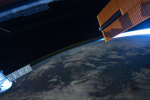 A Perseid Below
10.08.2014
Denizens of planet Earth typically watch meteor showers by looking up. But this remarkable view, captured on August 13, 2011 by astronaut Ron Garan, caught a Perseid meteor by looking down. From Garan...
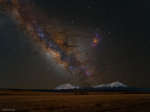 Milky Way Over the Spanish Peaks
24.05.2016
That's not lightning, and it did not strike between those mountains. The diagonal band is actually the central band of our Milky Way Galaxy, while the twin peaks are actually called the Spanish Peaks -- but located in Colorado, USA.
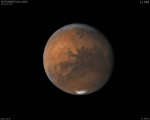 Solis Lacus: The Eye of Mars
1.10.2020
As telescopes around planet Earth watch, Mars is growing brighter in night skies, approaching its 2020 opposition on October 13. Mars looks like its watching too in this view of the Red Planet from September 22.
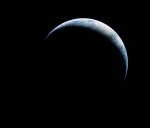 Apollo 17: The Crescent Earth
29.04.2021
Our fair planet sports a curved, sunlit crescent against the black backdrop of space in this stunning photograph. From the unfamiliar perspective, the Earth is small and, like a telescopic image of a distant planet, the entire horizon is completely within the field of view.
 APOD: 2024 August 26 Б Perseid Meteors Over Inner Mongolia
26.08.2024
Did you see it? One of the more common questions during a meteor shower occurs because the time it takes for a meteor to flash is similar to the time it takes for a head to turn.
|
January February March April May June July August September October |
|||||||||||||||||||||||||||||||||||||||||||||||||