
|
You entered: color
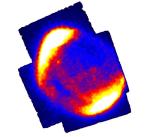 SN 1006: Pieces of the Cosmic Ray Puzzle
2.12.2000
Research balloon flights conducted in 1912 by Austrian physicist Victor Hess revealed that the Earth was constantly bombarded by high energy radiation from space - which came to be called "Cosmic Rays". What are Cosmic Rays and where do they come from?
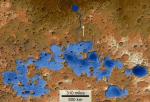 Carving Ma adim Vallis
27.06.2002
Just as erosion from the Colorado River carved the Grand Canyon on Earth, a river of flood water may have carved Ma'adim Vallis, one of the largest canyons on Mars. Researchers have presented...
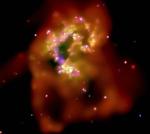 X Rays From Antennae Galaxies
3.02.2004
A bevy of black holes and neutron stars shine as bright, point-like sources against bubbles of million degree gas in this false-color x-ray image from the orbiting Chandra Observatory. The striking picture spans about...
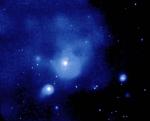 Fornax Cluster in Motion
24.09.2004
Reminiscent of popular images of the lovely Pleiades star cluster that lies within our own Milky Way Galaxy, this false-color x-ray view actually explores the center of a much more extended cosmic family -- the Fornax cluster of galaxies some 65 million light-years away.
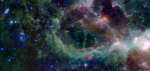 Galaxies Beyond the Heart: Maffei 1 and 2
9.03.2010
The two galaxies on the far left were unknown until 1968. Although they would have appeared as two of the brighter galaxies on the night sky, the opaque dust of the central band of our Milky Way Galaxy had obscured them from being seen in visible light.
 SDO s Multiwavelength Sun
21.12.2013
Today, the solstice is at 17:11 Universal Time, the Sun reaching the southernmost declination in its yearly journey through planet Earth's sky. The December solstice marks the astronomical beginning of winter in the northern hemisphere and summer in the south.
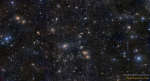 Virgo Cluster Galaxies
4.08.2015
Well over a thousand galaxies are known members of the Virgo Cluster, the closest large cluster of galaxies to our own local group. In fact, the galaxy cluster is difficult to appreciate all at once because it covers such a large area on the sky.
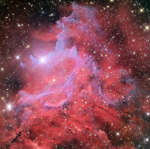 Flaming Star Nebula
1.12.2016
A runaway star lights the Flaming Star Nebula in this cosmic scene. Otherwise known as IC 405, the Flaming Star Nebula's billowing interstellar clouds of gas and dust lie about 1,500 light-years away toward the constellation of Auriga.
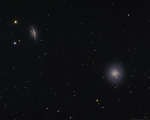 Cetus Galaxies and Supernova
6.12.2018
Large spiral galaxy NGC 1055 at top left joins spiral Messier 77 (bottom right) in this cosmic view toward the aquatic constellation Cetus. The narrowed, dusty appearance of edge-on spiral NGC 1055 contrasts nicely with the face-on view of M77's bright nucleus and spiral arms.
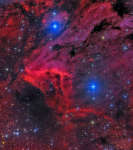 The Pelican Nebula in Red and Blue
1.03.2021
The Pelican Nebula is changing. The entire nebula, officially designated IC 5070, is divided from the larger North America Nebula by a molecular cloud filled with dark dust. The Pelican, however, is particularly interesting because it is an unusually active mix of star formation and evolving gas clouds.
|
January February March April May June July August |
||||||||||||||||||||||||||||||||||||||||||||||||||||||||