
|
You entered: sky
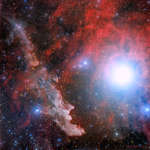 Rigel and the Witch Head Nebula
24.01.2022
By starlight this eerie visage shines in the dark, a crooked profile evoking its popular name, the Witch Head Nebula. In fact, this entrancing telescopic portrait gives the impression that the witch has fixed her gaze on Orion's bright supergiant star Rigel.
 APOD: 2023 May 17 Б Sunspot with Light Bridge
17.05.2023
Why would a small part of the Sun appear slightly dark? Visible is a close-up picture of sunspots, depressions on the Sun's surface that are slightly cooler and less bright than the rest of the Sun. The Sun's complex magnetic field creates these cool regions by inhibiting hot material from entering the spots.
 APOD: 2024 August 19 Б IC 5146: The Cocoon Nebula
19.08.2024
Inside the Cocoon Nebula is a newly developing cluster of stars. Cataloged as IC 5146, the beautiful nebula is nearly 15 light-years wide. Soaring high in northern summer night skies, it's located some 4,000 light years away toward the constellation of the Swan (Cygnus).
 NGC 6302: The Butterfly Nebula
6.06.2025
The bright clusters and nebulae of planet Earth's night sky are often given the names of flowers or insects, and its whopping 3 light-year wingspan, NGC 6302 is no exception. With an estimated...
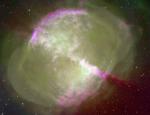 M27: The Dumbbell Nebula
6.03.2001
The first hint of what will become of our Sun was discovered inadvertently in 1764. At that time, Charles Messier was compiling a list of "annoying" diffuse objects not to be confused with "interesting" comets.
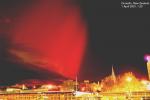 Aurora Over New Zealand
6.04.2001
Last weekend skygazers at middle and high latitudes around the globe were treated to expansive auroral displays as a magnetic storm raged around planet Earth. The storm was triggered by a solar coronal mass ejection associated with the giant sunspot group cataloged as active region number 9393.
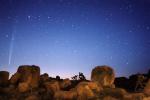 Comets Bradfield and LINEAR Rising
3.05.2004
Comet Bradfield is easy to see on the left, but can you find Comet LINEAR on the right? Last week, just before sunrise from the northern hemisphere, two bright comets were visible in the same part of the sky at the same time.
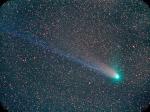 The Tails of Comet NEAT Q4
12.05.2004
Comet NEAT (Q4) is showing its tails. As the large snowball officially dubbed Comet C/2001 Q4 (NEAT) falls toward the inner Solar System, it has already passed the Earth and will reach its closest approach to the Sun this coming Saturday.
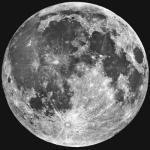 The Full Moon
19.04.1999
Earth has one moon. A symbol in famous love songs, movies, poems, and folklore, many myths about the Moon date back to ancient history. In fact, the name Monday originates from Moon-day. The Moon glows by light it reflects from the Sun and is frequently the brightest object in the night sky.
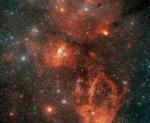 NGC 7635: Bubble in a Cosmic Sea
28.04.2006
Seemingly adrift in a cosmic sea of stars and glowing gas, the delicate, floating apparition near the center (next to a blue tinted star) of this widefield view is cataloged as NGC 7635 - The Bubble Nebula.
|
January February March April May June July August September October |
|||||||||||||||||||||||||||||||||||||||||||||||||