
|
You entered: image
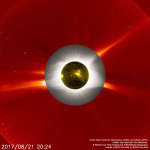 Layers of a Total Solar Eclipse
27.09.2017
Neither rain, nor snow, nor dark of night can keep a space-based spacecraft from watching the Sun. In fact, from its vantage point 1.5 million kilometers sunward of planet Earth, NASA's SOlar Heliospheric Observatory (SOHO) can always monitor the Sun's outer atmosphere, or corona.
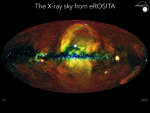 The X Ray Sky from eROSITA
23.06.2020
What if you could see X-rays? The night sky would seem a strange and unfamiliar place. X-rays are about 1,000 times more energetic than visible light photons and are produced by violent explosions and high temperature astronomical environments.
 UHZ1: Distant Galaxy and Black Hole
10.11.2023
Dominated by dark matter, massive cluster of galaxies Abell 2744 is known to some as Pandora's Cluster. It lies 3.5 billion light-years away toward the constellation Sculptor. Using the galaxy cluster's enormous...
 APOD: 2025 August 9 Б Interstellar Interloper 3I/ATLAS from Hubble
9.08.2025
Discovered on July 1 with the NASA-funded ATLAS (Asteroid Terrestrial-impact Last Alert System) survey telescope in Rio Hurtado, Chile, 3I/ATLAS is so designated as the third known interstellar object to pass through our Solar System. It follows 1I/йOumuamua in 2017 and the comet 2I/Borisov in 2019.
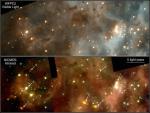 New Stars In 30 Doradus
1.10.1999
Compare these matched Hubble Space Telescope views (visible-light on top; infrared on bottom) of a region in the star-forming 30 Doradus Nebula. Find the numbered arrows in the infrared image which identify newborn massive stars. For example, arrows 1 and 5 both point to compact clusters of bright young stars.
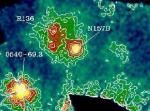 Ultra Fast Pulsar
11.02.1998
Pulsars are rotating neutron stars, born in the violent crucibles of supernova explosions. Like cosmic lighthouses, beams of radiation from surface hotspots sweep past our viewpoint creating pulses which reveal the rotation rates of these incredibly dense stellar corpses. The most famous pulsar of all is found in the nearby supernova remnant, the Crab Nebula.
 Sungrazer
22.03.2009
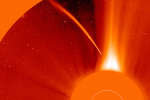
The Sun destroyed this comet. Arcing toward a fiery fate, this Sungrazer comet was recorded by the SOHO spacecraft's Large Angle Spectrometric COronagraph(LASCO) on 1996 Dec. 23. LASCO uses an occulting disk...
 High Energy Stereoscopic System II
27.07.2012
The largest of its kind, the High Energy Stereoscopic System (H.E.S.S.) II telescope stands in the foreground of this photo. Tilted horizontally it reflects the inverted landscape of the Namibian desert in a segmented mirror 24 meters wide and 32 meters tall, equal in area to two tennis courts.
 Curiosity Rover at Rocknest on Mars
27.12.2012
What's in this smooth soil on Mars? In late October, NASA's robotic Curiosity rover stopped near a place dubbed Rocknest as it continues to explore Gale Crater on Mars. Rocknest is the group of stones seen near the top left of the above image -- just to the left of Curiosity's mast.
 The Cats Eye Nebula in Optical and X-ray
7.11.2021
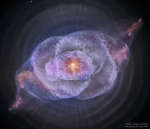
To some it looks like a cat's eye. To others, perhaps like a giant cosmic conch shell. It is actually one of brightest and most highly detailed planetary nebula known, composed of gas expelled in the brief yet glorious phase near the end of life of a Sun-like star.
|
January February March April May June July August September |
|||||||||||||||||||||||||||||||||||||||||||||||||