
|
You entered: telescope
 Visitors Galaxy Gallery
27.04.2001
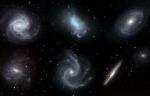
A tantalizing assortment of island universes is assembled here. From top left to bottom right are the lovely but distant galaxies M61, NGC 4449, NGC 4725, NGC 5068, NGC 5247, and NGC 5775/5774. Most are spiral galaxies more or less like our own Milky Way.
 Venusian Half Shell
11.12.2001
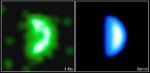
Venus, second planet from the Sun, appears above imaged for the first time ever in x-rays (left) by the orbiting Chandra Observatory. Chandra's smoothed, false-color, x-ray view is compared to an optical image (right) from a small earthbound telescope.
 Ring Galaxy AM 0644 741 from Hubble
26.04.2004
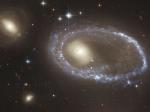
How could a galaxy become shaped like a ring? The rim of the blue galaxy pictured on the right is an immense ring-like structure 150,000 light years in diameter composed of newly formed, extremely bright, massive stars.
 APOD: 2023 June 29 Б A Message from the Gravitational Universe
29.06.2023
Monitoring 68 pulsars with very large radio telescopes, the North American Nanohertz Observatory for Gravitational Waves (NANOGrav) has uncovered evidence for the gravitational wave (GW) background by carefully measuring slight shifts in the arrival times of pulses. These shifts are correlated between different pulsars in a way that indicates that they are caused by GWs.
 M64: The Black Eye Galaxy
20.07.2023
This magnificent spiral galaxy is Messier 64, often called the Black Eye Galaxy or the Sleeping Beauty Galaxy for its dark-lidded appearance in telescopic views. The spiral's central region, about 7,400 light-years across, is pictured in this reprocessed image from the Hubble Space Telescope.
 Comet C/2025 F2 SWAN
18.04.2025
In late March, the comet now designated C/2025 F2 SWAN was found independently by citizen scientists Vladimir Bezugly, Michael Mattiazzo, and Rob Matson while examining publicly available image data from the Solar Wind ANisotropies (SWAN) camera on the sun-staring SOHO spacecraft.
 Blue Stragglers In NGC 6397
22.06.2000
In our neck of the Galaxy stars are too far apart to be in danger of colliding, but in the dense cores of globular star clusters star collisions may be relatively common. In fact...
 The Center of Globular Cluster Omega Centauri
10.10.2001
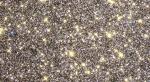
What is left over after stars collide? To help answer this question, astronomers have been studying the center of the most massive ball of stars in our Milky Way Galaxy. In the center of globular cluster Omega Centauri, stars are packed in 10,000 times more densely than near our Sun.
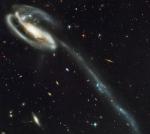 Arp 188 and the Tadpole s Tidal Tail
2.05.2002
In this stunning vista recorded with the Hubble Space Telescope's new advanced camera, distant galaxies form a dramatic backdrop for disrupted spiral galaxy Arp 188, the Tadpole Galaxy. The cosmic Tadpole is a mere 420 million light-years distant toward the northern constellation Draco.
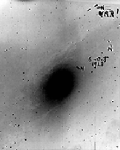 Andromeda Nebula: Var!
6.04.1996
In the 1920s, using photographic plates made with the Mt. Wilson Observatory's 100 inch telescope, Edwin Hubble determined the distance to the Andromeda Nebula - decisively demonstrating the existence of other galaxies far beyond the Milky Way.
|
January February March April May |
|||||||||||||||||||||||||||||||||||||||||||||||||