
|
You entered: dark
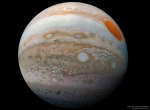 Jupiter Marble from Juno
8.05.2019
What does Jupiter look like up close? Most images of Jupiter are taken from far away, either from Earth or from a great enough distance that nearly half the planet is visible. This shot, though, was composed from images taken relatively close in, where less than half of the planet was visible.
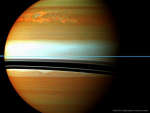 A Long Storm System on Saturn
15.09.2019
It was one of the largest and longest lived storms ever recorded in our Solar System. First seen in late 2010, the above cloud formation in the northern hemisphere of Saturn started larger than the Earth and soon spread completely around the planet.
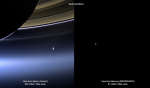 Interplanetary Earth
12.10.2019
In an interplanetary first, on July 19, 2013 Earth was photographed on the same day from two other worlds of the Solar System, innermost planet Mercury and ringed gas giant Saturn. Pictured...
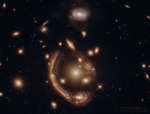 A Molten Galaxy Einstein Ring Galaxy
5.07.2022
It is difficult to hide a galaxy behind a cluster of galaxies. The closer cluster's gravity will act like a huge lens, pulling images of the distant galaxy around the sides and greatly distorting them. This is just the case observed in the featured image recently re-processed image from the Hubble Space Telescope.
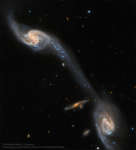 Galaxies: Wilds Triplet from Hubble
8.11.2022
How many galaxies are interacting here? This grouping of galaxies is called the Wild Triplet, not only for the discoverer, but for the number of bright galaxies that appear. It had been assumed that...
 A Perseid Below
9.08.2024
Denizens of planet Earth typically watch meteor showers by looking up. But this remarkable view, captured on August 13, 2011 by astronaut Ron Garan, caught a Perseid meteor by looking down. From Garan...
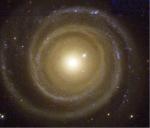 The Spiral Arms of NGC 4622
25.01.2002
While stirring a morning cup of coffee and thinking cosmic thoughts many astronomers would glance at this Hubble Space Telescope image of spiral galaxy NGC 4622 and assume that the galaxy was rotating counterclockwise in the picture.
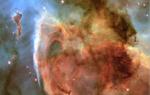 Colorful Clouds Of Carina
3.02.2000
Tumultuous clouds of the Carina Nebula, 8000 light-years away, glow in planet Earth's southern sky. Striking and detailed, this close-up of a portion of the famous nebula is a combination of exposures through six different filters taken with the Hubble Space Telescope's Wide Field Planetary Camera 2 in April of 1999.
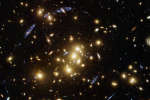 Giant Cluster Bends, Breaks Images
23.08.2009
What are those strange blue objects? Many of the brightest blue images are of a single, unusual, beaded, blue, ring-like galaxy which just happens to line-up behind a giant cluster of galaxies. Cluster galaxies here typically appear yellow and -- together with the cluster's dark matter -- act as a gravitational lens.
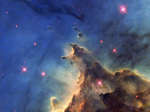 NGC 2174: Stars Versus Mountains
9.02.2011
It's stars versus gas mountains in NGC 2174 and the stars are winning. More precisely, the energetic light and winds from massive newly formed stars are evaporating and dispersing the dark stellar nurseries in which they formed.
|
January February March April May June July August September |
|||||||||||||||||||||||||||||||||||||||||||||||||