
|
You entered: wind
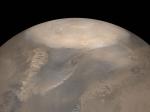 Spring Dust Storms at the North Pole of Mars
24.12.2002
Spring reached the north pole of Mars in May, and brought with it the usual dust storms. As the north polar cap begins to thaw, a temperature difference occurs between the cold frost region and recently thawed surface, resulting in swirling winds between the adjacent regions.
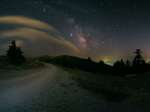 Milky Way Road Trip
5.09.2008
In search of planets and the summer Milky Way, astronomer Tunç Tezel took an evening road trip. Last Saturday, after driving the winding road up Uludag, a mountain near Bursa, Turkey, he was rewarded by this beautiful skyview to the south.
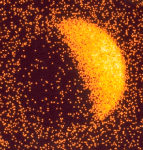 X-Raying the Moon
31.08.1995
Above is a picture of the Moon taken in X-rays by the Roentgen Observatory Satellite ROSAT in 1990. This famous picture shows three distinct regions: a bright X-ray sky, a bright part of the Moon, and a relatively dark part of the Moon.
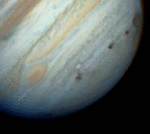 Comet Impacts on Jupiter
14.07.1995
In July of 1994, pieces of Comet Shoemaker-Levy 9, also known as the "string of pearls" comet, collided with the planet Jupiter. As the comet fragments smashed in to Jupiter, the resulting explosions scattered large quantities of dusty cometary debris into the Jovian atmosphere.
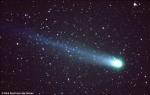 Hyakutake: Stars Through A Comet Tail
17.07.1998
Comets are cosmic icebergs. They follow very elongated orbits which carry them from the frozen, remote outer reaches of the Solar System to close encounters with the Sun. Heated by sunlight, they slough off layers of material as gas and dust, forming their characteristic awe-inspiring comas (heads) and tails.
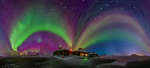 Lapland Northern Lights
8.04.2016
Early spring in the northern hemisphere is good season for aurora hunters. Near an equinox Earth's magnetic field is oriented to favor interactions with the solar wind that trigger the alluring glow of the northern lights. On March 28/29 the skies over Kaunispää Hill, Lapland, Finland did not disappoint.
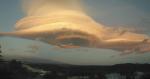 A Lenticular Cloud Over Hawaii
1.12.2003
Can a cloud do that? Actually, pictured above are several clouds all stacked up into one striking lenticular cloud. Normally, air moves much more horizontally than it does vertically. Sometimes, however, such as when wind comes off of a mountain or a hill, relatively strong vertical oscillations take place as the air stabilizes.
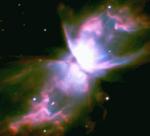 NGC 6302: The Butterfly Nebula
2.06.1998
The Butterfly Nebula is only thousands of years old. As a central star of a binary system aged, it threw off its outer envelopes of gas in a strong stellar wind. The remaining stellar core is so hot it ionizes the previously ejected gas, causing it to glow.
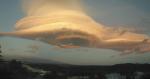 A Lenticular Cloud Over Hawaii
21.08.2005
Can a cloud do that? Actually, pictured above are several clouds all stacked up into one striking lenticular cloud. Normally, air moves much more horizontally than it does vertically. Sometimes, however, such as when wind comes off of a mountain or a hill, relatively strong vertical oscillations take place as the air stabilizes.
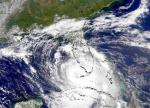 A Hurricane in the Gulf
28.09.1998
Last Friday, Hurricane Georges was photographed from space entering the Gulf of Mexico. This immense storm system, larger than most states, is expected to make landfall today. Starting as a slight pressure difference, hurricanes grow into large spiraling storm systems of low pressure, complete with high winds and driving rain.
|
January February March April May June July August |
||||||||||||||||||||||||||||||||||||||||||||||||||||||||