
|
You entered: southern sky
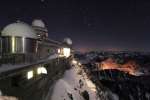 Winter Night at Pic du Midi
25.01.2008
This dreamlike view looking south from the historic mountain top Pic du Midi Observatory combines moonlit domes, a winter night sky, and the snowy peaks of the French Pyrenees. Encroaching on the night, lights...
 Galaxy in a Crystal Ball
22.06.2018
A small crystal ball seems to hold a whole galaxy in this creative snapshot. Of course, the galaxy is our own Milky Way. Its luminous central bulge marked by rifts of interstellar dust spans thousands of light-years. On this long southern hemisphere night it filled dark Chilean skies over Paranal Observatory.
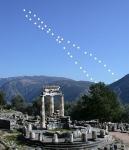 Sunrise Analemma
20.03.2003
Astronomically speaking, at the Equinox on March 21, 01:00 UT (March 20, 8:00 PM ET) the season changes. For this Equinox the Sun rises due east as it crosses the celestial equator heading north. In celebration, consider this spectacular sunrise analemma!
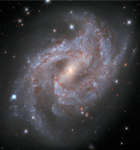 Supernova in NGC 2525
23.10.2020
Big, beautiful, barred spiral galaxy NGC 2525 lies 70 million light-years from the Milky Way. It shines in Earth's night sky within the boundaries of the southern constellation Puppis. About 60,000 light-years...
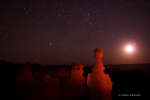 Hoodoo Sky
3.07.2008
The strange-looking rock formations in the foreground of this skyscape are called hoodoos. Towers of weathered, eroded sedimentary rock, hoodoos are found in arid regions of planet Earth and are particularly abundant in an area known as Bryce Canyon National Park in southern Utah, USA.
 Aurora Georgia
16.05.2024
A familiar sight from Georgia, USA, the Moon sets near the western horizon in this rural night skyscape. Captured on May 10 before local midnight, the image overexposes the Moon's bright waning crescent at left in the frame. A long irrigation rig stretches across farmland about 15 miles north of the city of Bainbridge.
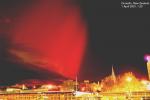 Aurora Over New Zealand
6.04.2001
Last weekend skygazers at middle and high latitudes around the globe were treated to expansive auroral displays as a magnetic storm raged around planet Earth. The storm was triggered by a solar coronal mass ejection associated with the giant sunspot group cataloged as active region number 9393.
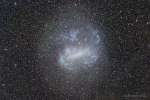 APOD: 2023 March 7 Б Deep Field: The Large Magellanic Cloud
7.03.2023
Is this a spiral galaxy? No. Actually, it is the Large Magellanic Cloud (LMC), the largest satellite galaxy of our own Milky Way Galaxy. The LMC is classified as a dwarf irregular galaxy because of its normally chaotic appearance. In this deep and wide exposure, however, the full extent of the LMC becomes visible.
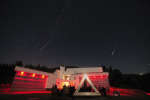 Meteors Over Quebec
16.08.2010
Meteors streaked through the sky above many of Earth's cities last week, but nobody was hurt, and no damage has been reported. The assault from space appeared to originate from someplace in the constellation of Perseus, and included millions of small projectiles hurtling toward Earth at over 200,000 kilometers per hour.
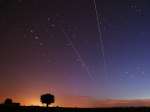 Chasing the ISS
4.06.2008
Bathed in sunlight, the International Space Station (ISS) arced through the evening sky above the town of Lauffen in southern Germany on May 31st. The timing of the bright passage was about 10 minutes after the launch of the Space Shuttle Discovery on the STS-124 mission from Kennedy Space Center, Florida, in the southeastern US.
|
January February March April May |
|||||||||||||||||||||||||||||||||||||||||||||||||