
|
You entered: nearest stars
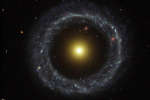 Hoags Object: A Strange Ring Galaxy
22.08.2010
Is this one galaxy or two? This question came to light in 1950 when astronomer Art Hoag chanced upon this unusual extragalactic object. On the outside is a ring dominated by bright blue stars, while near the center lies a ball of much redder stars that are likely much older.
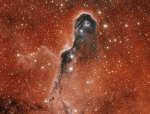 An Unusual Globule in IC 1396
14.04.2014
Is there a monster in IC 1396? Known to some as the Elephant's Trunk Nebula, parts of gas and dust clouds of this star formation region may appear to take on foreboding forms, some nearly human. The only real monster here, however, is a bright young star too far from Earth to hurt us.
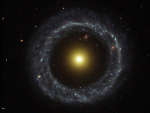 Hoags Object: A Strange Ring Galaxy
28.07.2013
Is this one galaxy or two? This question came to light in 1950 when astronomer Art Hoag chanced upon this unusual extragalactic object. On the outside is a ring dominated by bright blue stars, while near the center lies a ball of much redder stars that are likely much older.
 Kembles Cascade
14.08.2000
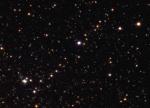
A picturesque chain of unrelated stars is visible with strong binoculars towards the constellation of Camelopardalis. Known as Kemble's Cascade, the asterism contains about 20 stars nearly in a row stretching over five times the width of a full moon.
 Kembles Cascade
5.12.2004
A picturesque chain of unrelated stars is visible with strong binoculars towards the constellation of Camelopardalis. Known as Kemble's Cascade, the asterism contains about 20 stars nearly in a row stretching over five times the width of a full moon.
 Summer Night in Astronomy Town
12.09.2009
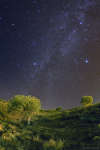
This serene view records a late summer night sky over the rolling, green hills of planet Earth. It was taken near the rural village of Saadat Shahr, Fars province, in southern Iran. Saadat Shahr is also known as Astronomy Town, as the inhabitants have demonstrated a remarakble passion for sky gazing.
 A Path North
7.04.2020
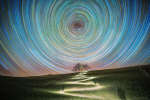
What happens if you keep going north? The direction north on the Earth, the place on your horizon below the northern spin pole of the Earth -- around which other stars appear to slowly swirl, will remain the same.
 Star Colors in Orion
11.02.2011
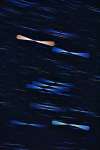
What determines a star's color? Its temperature. Red stars are cool, with surface temperatures of around 3,000 kelvins (K), while blue stars are hotter and can have temperatures over 30,000 K. Our own lovely "yellow" Sun's temperature is a comforting 6,000 K.
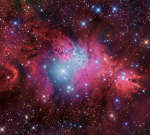 Fox Fur, Unicorn, and Christmas Tree
7.02.2019
Clouds of glowing hydrogen gas fill this colorful skyscape in the faint but fanciful constellation Monoceros, the Unicorn. A star forming region cataloged as NGC 2264, the complex jumble of cosmic gas and dust...
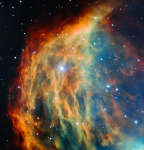 The Medusa Nebula
12.06.2015
Braided, serpentine filaments of glowing gas suggest this nebula's popular name, The Medusa Nebula. Also known as Abell 21, this Medusa is an old planetary nebula some 1,500 light-years away along the southern border of the constellation Gemini. Like its mythological namesake, the nebula is associated with a dramatic transformation.
|
January February March April May June July August September October |
|||||||||||||||||||||||||||||||||||||||||||||||||