
|
You entered: massive stars
 APOD: 2023 May 22 Б Supernova Discovered in Nearby Spiral Galaxy M101
22.05.2023
A nearby star has exploded and humanity's telescopes are turning to monitor it. The supernova, dubbed SN 2023ifx, was discovered by Japanese astronomer Koichi Itagaki three days ago and subsequently located on automated images from the Zwicky Transient Facility two days earlier.
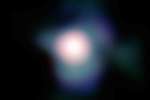 Betelgeuse Resolved
5.08.2009
The sharpest image ever of Betelgeuse shows a mammoth star that is slowly evaporating. Betelgeuse (sounds a lot like "beetle juice"), also known as Alpha Orionis, is one of the largest and brightest stars known. The star is a familiar orange fixture easily visible to the unaided eye toward the constellation of Orion.
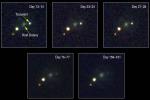 Gamma Ray Burst, Supernova Bump
17.05.2002
On the 21st of November 2001, satellites detected yet another burst of gamma-rays from the cosmos. While this flash of high-energy photons lasted for less than a minute, eager astronomers have been following the fading optical light from the location of the burst source ever since.
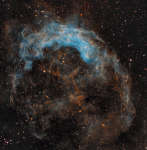 Windblown NGC 3199
6.05.2021
NGC 3199 lies about 12,000 light-years away, a glowing cosmic cloud in the nautical southern constellation of Carina. The nebula is about 75 light-years across in this narrowband, false-color view. Though the deep...
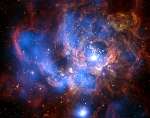 NGC 604: X rays from a Giant Stellar Nursery
5.02.2009
Some 3 million light-years distant in nearby spiral galaxy M33, giant stellar nursery NGC 604 is about 1,300 light-years across, or nearly 100 times the size of the Orion Nebula. In fact, among...
 Elements in the Aftermath
1.08.2019
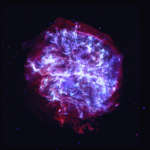
Massive stars spend their brief lives furiously burning nuclear fuel. Through fusion at extreme temperatures and densities surrounding the stellar core, nuclei of light elements ike Hydrogen and Helium are combined to heavier elements like Carbon, Oxygen, etc. in a progression which ends with Iron.
 Cosmic Clouds in Cygnus
9.06.2022
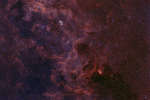
These cosmic clouds of gas and dust drift through rich star fields along the plane of our Milky Way Galaxy toward the high flying constellation Cygnus. They're too faint to be seen with the unaided eye though, even on a clear, dark night.
 Spiral Galaxy NGC 4038 in Collision
12.08.2012
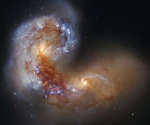
This galaxy is having a bad millennium. In fact, the past 100 million years haven't been so good, and probably the next billion or so will be quite tumultuous. Visible on the upper...
 Starburst Galaxy M94 from Hubble
31.07.2022
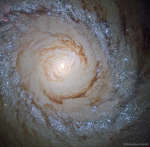
Why does this galaxy have a ring of bright blue stars? Beautiful island universe Messier 94 lies a mere 15 million light-years distant in the northern constellation of the Hunting Dogs (Canes Venatici).
 Yellow Balls in W33
30.01.2015
Infrared wavelengths of 3.6, 8.0, and 24.0 microns observed by the Spitzer Space Telescope are mapped into visible colors red, green, and blue in this striking image. The cosmic cloud of gas and dust is W33, a massive starforming complex some 13,000 light-years distant, near the plane of our Milky Way Galaxy.
|
January February March April May |
|||||||||||||||||||||||||||||||||||||||||||||||||