
|
You entered: ionization
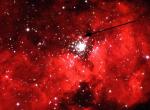 Sher 25: A Pending Supernova?
12.08.1997
No supernova has ever been predicted - yet. These dramatic stellar explosions that destroy stars, that create and disperse the elements that compose people and planets, that light up the night sky, are not so well understood that astronomers can accurately predict when a star will explode - yet. Perhaps Sher 25 will be the first.
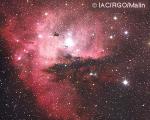 NGC 281: Cluster, Clouds, and Globules
21.09.1998
NGC 281 is a busy workshop of star formation. Prominent features include a small open cluster of stars, a diffuse red-glowing emission nebula, large lanes of obscuring gas and dust, and dense knots of dust and gas in which stars may still be forming.
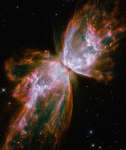 The Butterfly Nebula from Upgraded Hubble
10.09.2009
The bright clusters and nebulae of planet Earth's night sky are often named for flowers or insects, and NGC 6302 is no exception. With an estimated surface temperature of about 250,000 degrees...
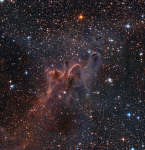 Cometary Globules
12.10.2013
Bright-rimmed, flowing shapes gather near the center of this rich starfield toward the boarders of the nautical southern constellations Pupis and Vela. Composed of interstellar gas and dust, the grouping of light-year sized cometary globules is about 1300 light-years distant.
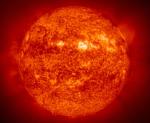 Helios Helium
20.01.2001
This image of the active Sun was made using ultraviolet light emitted by ionized Helium atoms in the Solar chromosphere. Helium was first discovered in the Sun in 1868, its name fittingly derived from from the Greek word Helios, meaning Sun. Credit for the discovery goes to astronomer Joseph Norman Lockyer (born May 17, 1836).
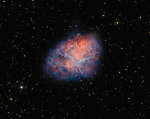 M1: The Crab Nebula
20.11.2014
The Crab Nebula is cataloged as M1, the first object on Charles Messier's famous 18th century list of things which are not comets. In fact, the Crab is now known to be a supernova remnant, debris from the death explosion of a massive star, witnessed by astronomers in the year 1054.
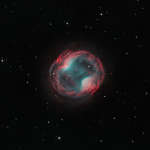 APOD: 2026 May 27 Б PK 164 +31.1: The Headphone Nebula
27.05.2026
What is a pair of headphones doing in the sky? TodayБs image features the Headphone Nebula, also known as PK 164 +31.1 or Jones-Emberson 1. This planetary nebula, the remnant of a dying Sun-like star, faintly occupies an angular region of the Lynx constellation about 1/5 th the diameter of the full moon.
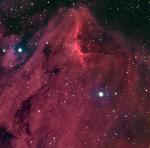 The Pelican in the Swan
29.08.2002
The Pelican Nebula, also known as IC 5070, lies about 2,000 light-years away in the high and far-off constellation of Cygnus, the Swan. This picture spans a portion of the magnificent nebula about 30 light-years wide.
 A Halo for Andromeda
3.09.2020
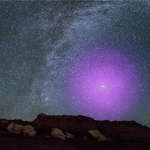
M31, the Andromeda Galaxy, is the closest large spiral galaxy to our Milky Way. Some 2.5 million light-years distant it shines in Earth's night sky as a small, faint, elongated cloud just visible to the unaided eye.
 NGC 1499: California Nebula
10.03.2005
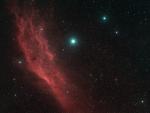
Drifting through the Orion Arm of the spiral Milky Way Galaxy, this cosmic cloud by chance echoes the outline of California on the west coast of the United States. Our own Sun also lies within the Milky Way's Orion Arm, only about 1,500 light-years from the California Nebula.
|
January February March April May June July August September |
|||||||||||||||||||||||||||||||||||||||||||||||||