
|
You entered: horizon
 Sun Halo at Sixty three Degrees North
21.12.2022
Happy Solstice! Today is the December solstice, marking an astronomical beginning of summer in the southern hemisphere and winter in the north. On its yearly trek through planet Earth's skies, at this solstice the Sun reaches its southern most declination, 23.5 degrees south, at 21:48 UTC.
 Pluto: From Mountains to Plains
14.12.2015
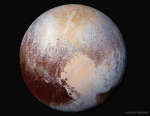
What do the sharpest views ever of Pluto show? As the robotic New Horizons spacecraft moves into the outer Solar System, it is now sending back some of the highest resolution images from its historic encounter with Pluto in July. Featured here is one recently-received, high-resolution image.
 Pluto in Enhanced Color
31.08.2015
Pluto is more colorful than we can see. Color data and images of our Solar System's most famous dwarf planet, taken by the robotic New Horizons spacecraft during its flyby in July, have been digitally combined to give an enhanced view of this ancient world sporting an unexpectedly young surface.
 Pluto from above Cthulhu Regio
14.09.2015
New high resolution images of Pluto are starting to arrive from the outer Solar System. The robotic New Horizons spacecraft, which zoomed by Pluto in July, has finished sending back some needed engineering data and is now transmitting selections from its tremendous storehouse of images of Pluto and its moons.
 A Tale of Two Hemispheres
30.07.2011
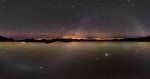
A quest to find planet Earth's darkest night skies led to this intriguing panorama. In projection, the mosaic view sandwiches the horizons visible in all-sky images taken from the northern hemisphere's Canary Island of La Palma (top) and the south's high Atacama Desert between the two hemispheres of the Milky Way Galaxy.
 Shadow Of Phobos
5.11.1999
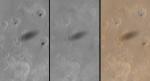
Hurtling through space above the Red Planet, potato-shaped Phobos completes an orbit of Mars in less than eight hours. In fact, since its orbital period is shorter than the planet's rotation period, Mars-based...
 Pluto in Enhanced Color
1.08.2021
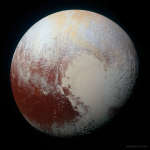
Pluto is more colorful than we can see. Color data and high-resolution images of our Solar System's most famous dwarf planet, taken by the robotic New Horizons spacecraft during its flyby in 2015 July, have been digitally combined to give an enhanced-color view of this ancient world sporting an unexpectedly young surface.
 Zodiacal Light and the False Dawn
12.09.2001
An unusual triangle of light will be particularly bright near the eastern horizon before sunrise during the next two months for observers in Earth's northern hemisphere. Once considered a false dawn, this triangle of light is actually Zodiacal Light, light reflected from interplanetary dust particles.
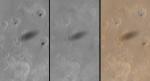 The Shadow of Phobos
17.09.2005
(xxxedit and linkxxx) Hurtling through space above the Red Planet, potato-shaped Phobos completes an orbit of Mars in less than eight hours. In fact, since its orbital period is shorter than the planet...
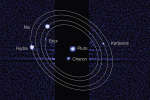 Plutos Newly Discovered Moons Receive Names
8.07.2013
Pluto's newly discovered moons now have names. Known previously as P4 and P5, the International Astronomical Union has now given the fourth and fifth discovered moons of Pluto the names Kerberos and Styx.
|
January February March April May June July August |
||||||||||||||||||||||||||||||||||||||||||||||||||||||||