
|
You entered: halo
 APOD: 2024 January 3 Б A SAR Arc from New Zealand
3.01.2024
What is that unusual red halo surrounding this aurora? It is a Stable Auroral Red (SAR) arc. SAR arcs are rare and have only been acknowledged and studied since 1954. The featured wide-angle photograph...
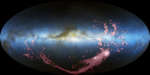 The Magellanic Stream
25.01.2010
Spanning the sky toward the majestic Clouds of Magellan is an unusual stream of gas: the Magellanic Stream. The origin of this gas remains unknown but likely hold a clue to origin and fate of our Milky Way's most famous satellite galaxies: the LMC and the SMC.
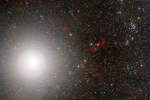 In the Glare of Alpha Centauri
28.06.2012
The glare of Alpha Centauri, one of the brightest stars in planet Earth's night sky, floods the left side of this southern skyscape. A mere 4.3 light-years distant, Alpha Centauri actually consists of two component stars similar in size to the Sun, locked in a mutual orbit.
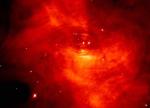 The Pulsar Powered Crab
5.09.1998
In the Summer of 1054 A.D. Chinese astronomers reported that a star in the constellation of Taurus suddenly became as bright as the full Moon. Fading slowly, it remained visible for over a year.
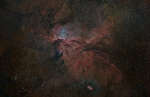 NGC 6188 and NGC 6164
1.02.2014
Fantastic shapes lurk in clouds of glowing gas in NGC 6188, about 4,000 light-years away. The emission nebula is found near the edge of a large molecular cloud unseen at visible wavelengths, in the southern constellation Ara.
 The Pulsar Powered Crab
31.05.1996
In the Summer of 1054 A.D. Chinese astronomers reported that a star in the constellation of Taurus suddenly became as bright as the full Moon. Fading slowly, it remained visible for over a year.
|
January February March April May June July August September |
|||||||||||||||||||||||||||||||||||||||||||||||||