
|
You entered: dust disk
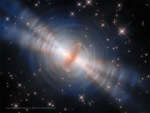 APOD: 2026 February 25 Б The Egg Nebula from the Hubble Telescope
25.02.2026
Ever wonder what it would look like to crack open the Sun? The Egg Nebula, a dying Sun-like star, can unscramble this question. Pictured is a combination of several visible and infrared images of the nebula (also known as RAFGL 2688 or CRL 2688) taken with the Hubble Space Telescope.
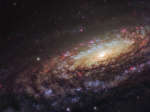 NGC 7331 Close Up
22.09.2022
Big, beautiful spiral galaxy NGC 7331 is often touted as an analog to our own Milky Way. About 50 million light-years distant in the northern constellation Pegasus, NGC 7331 was recognized early on as a spiral nebula and is actually one of the brighter galaxies not included in Charles Messier's famous 18th century catalog.
 APOD: 2025 August 31 Б NGC 7027: The Pillow Planetary Nebula
31.08.2025
What created this unusual planetary nebula? Dubbed the Pillow Nebula and the Flying Carpet Nebula, NGC 7027 is one of the smallest, brightest, and most unusually shaped planetary nebulas known. Given its expansion rate, NGC 7027 first started expanding, as visible from Earth, about 600 years ago.
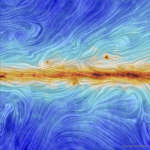 Our Galaxys Magnetic Field from Planck
26.01.2015
What does the magnetic field of our Galaxy look like? It has long been known that a modest magnetic field pervades our Milky Way Galaxy because it is seen to align small dust grains that scatter background light. Only recently, however, has the Earth-orbiting Planck satellite made a high-resolution map of this field.
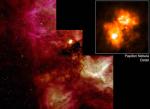 N159 and the Papillon Nebula
14.06.1999
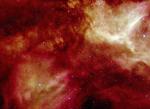
In a search for massive stars, the Hubble Space Telescope has peered into yet another spectacular region of star formation. This nebula, known as N159, spans over 150 light-years and is located in the neighboring Large Magellanic Cloud galaxy, about 170,000 light years distant.
 N159 and the Papillon Nebula
21.12.2003
In a search for massive stars, the Hubble Space Telescope has peered into yet another spectacular region of star formation. This nebula, known as N159, spans over 150 light-years and is located in the neighboring Large Magellanic Cloud galaxy, about 170,000 light years distant.
 Across the Center of Centaurus A
29.11.2011
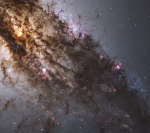
A fantastic jumble of young blue star clusters, gigantic glowing gas clouds, and imposing dark dust lanes surrounds the central region of the active galaxy Centaurus A. This image from the Hubble Space Telescope has been processed to present a natural color picture of this cosmic maelstrom.
 M106 Across the Spectrum
5.07.2014
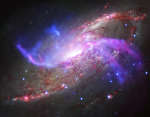
The spiral arms of bright, active galaxy M106 sprawl through this remarkable multiwavelength portrait, composed of image data from radio to X-rays, across the electromagnetic spectrum. Also known as NGC 4258, M106 can be found toward the northern constellation Canes Venatici.
 Surprising Comet ISON
30.11.2013
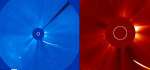
After failing to appear for Sun staring spacecraft at perihelion, its harrowing closest approach to the Sun, sungrazing Comet ISON was presumed lost. But ISON surprised observers yesterday as material still traveling along the comet's trajectory became visible and even developed an extensive fan-shaped dust tail.
 The Center of Centaurus A
22.05.1998
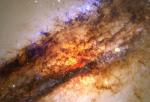
A fantastic jumble of young blue star clusters, gigantic glowing gas clouds, and imposing dark dust lanes surrounds the central region of the active galaxy Centaurus A. This mosaic of Hubble Space Telescope images taken in blue, green, and red light has been processed to present a natural color picture of this cosmic maelstrom.
|
January February March April May June July August September |
|||||||||||||||||||||||||||||||||||||||||||||||||